
TL;DR:
- Most organizations treat data quality as a technical issue, but overlooking its strategic importance costs millions annually. High-quality data is essential for reliable AI, marketing, and decision-making, as poor data compounds downstream problems and erodes trust. Sustaining data quality requires continuous monitoring, clear ownership, and fixing errors at their source to prevent costly downstream failures.
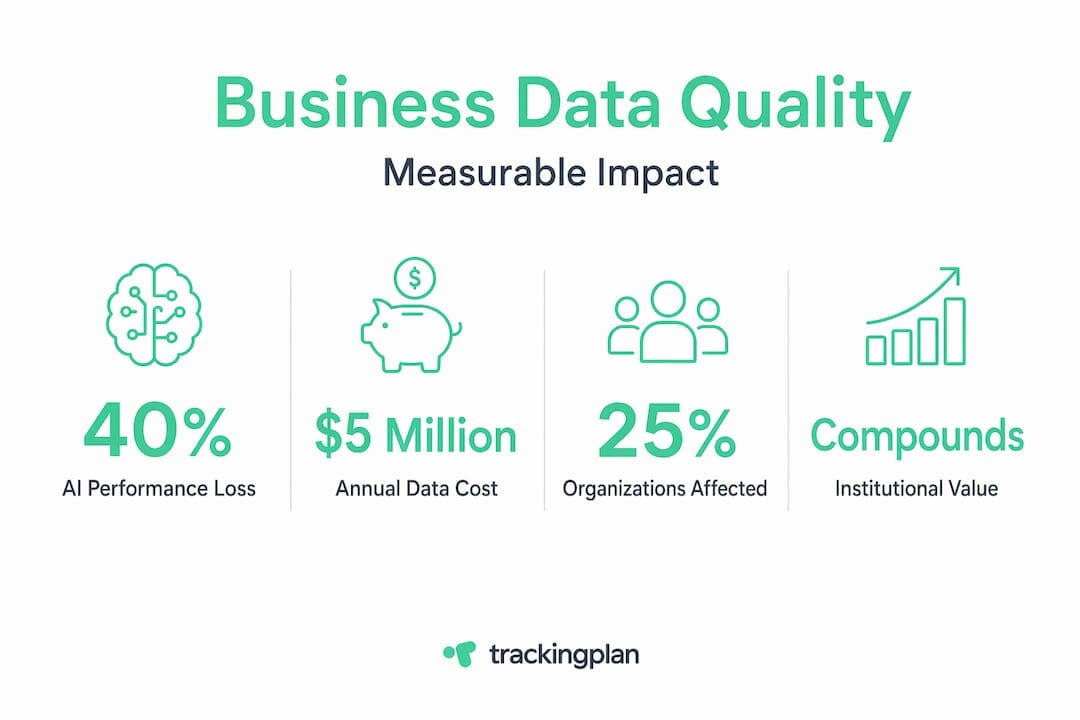
Most organizations treat data quality as a technical problem sitting somewhere between IT and operations. That framing is costing them millions. Over 25% of organizations lose more than $5 million annually because of poor data quality, and those losses rarely show up as a single catastrophic failure. They compound quietly: a bad customer record here, a misconfigured tracking pixel there, and suddenly your AI model is giving you bad predictions and your marketing team is optimizing against phantom conversions. Understanding why data quality is important means recognizing that it is not just a data problem. It is a strategy problem, a revenue problem, and in 2026, an AI problem.
Table of Contents
- Key Takeaways
- Why data quality is important: understanding the fundamentals
- The real cost of poor data quality
- Data quality as the foundation of AI success
- How to improve data quality in practice
- The business benefits of high data quality
- My perspective on data quality in 2026
- How Trackingplan helps you maintain data quality
- FAQ
Key Takeaways
| Point | Details |
|---|---|
| Poor data is expensive | More than a quarter of organizations lose over $5 million per year from data quality failures. |
| AI amplifies bad data | Low-quality inputs can reduce AI model performance by up to 40%, making clean data the real competitive advantage. |
| Errors compound downstream | One bad data field can disrupt three or more downstream processes, multiplying its damage across systems. |
| Fix quality at the source | Correcting data errors at the point of origin prevents far more expensive cleanup and rework later. |
| Data quality drives trust | When data is unreliable, business users abandon analytics tools and revert to unmanaged manual processes. |
Why data quality is important: understanding the fundamentals
Before you can fix something, you need to know what “good” actually looks like. Data quality is not simply about having data that is clean or deduplicated. It means your data is fit for its intended use, a distinction that matters enormously in practice.
A customer email address might be correctly formatted but completely outdated, making it technically valid and practically useless. A product SKU might be consistent across your database but mapped to the wrong category in your analytics warehouse. Clean does not automatically mean useful.
Most data quality frameworks organize around a set of core dimensions. The most widely cited include:
- Accuracy: Does the data correctly reflect the real-world entity it represents?
- Completeness: Are all required fields present and populated?
- Consistency: Does the data mean the same thing across different systems and records?
- Timeliness: Is the data current enough to be relevant for the decision at hand?
- Conformity: Does the data follow the expected formats, schemas, and business rules?
Some frameworks extend this to a “5 Cs” model that folds in currency, referring to how recently the data was updated relative to the rate of change in the underlying reality. For fast-moving data like website events, ad campaign parameters, or customer behaviors, currency can be just as damaging a failure point as accuracy.
What ties all these dimensions together is a simple test: can the person or system using this data make a confident, correct decision with it? If the answer is no, you have a data quality issue regardless of which dimension is failing you. High-quality data enables better analytics, personalized customer experiences, regulatory compliance, and reliable automation. Every dimension you neglect chips away at that potential.

The real cost of poor data quality
The financial losses are the most cited reason, but money is only part of the picture. Poor data quality issues are often invisible at origin and only manifest downstream as lost revenue and operational friction, which is exactly what makes them so dangerous.
“7% of organizations report annual losses exceeding $25 million directly attributable to poor data quality.” — IBM
Unity Technologies discovered this the hard way. The company lost approximately $110 million because bad data fed into their AI advertising system caused it to target the wrong users. The algorithm was not broken. The data feeding it was.
The operational damage extends beyond headline-grabbing losses. Consider what happens when a single field is recorded incorrectly. One bad data point can cascade through three or more downstream processes, breaking integrations, corrupting automated workflows, and triggering a chain of expensive manual interventions to trace back the source.
Other serious consequences organizations face include:
- Compliance and privacy risk: Inaccurate or incomplete data creates exposure under GDPR, CCPA, and similar regulations, where penalties scale with the size of the violation.
- Customer trust damage: Sending the wrong message to the wrong person because of a segmentation error is not just inefficient. It signals to customers that you do not actually know them.
- Marketing waste: Poor-quality contact data causes higher bounce rates, spam complaints, and domain reputation damage that can take months to recover from.
- Stakeholder abandonment: When reports are consistently unreliable, business users stop trusting analytics tools and build their own spreadsheets instead. This shadow analytics problem is far more widespread than most organizations admit.
The common thread across all these consequences is that the damage scales with time. The later you catch a data quality problem, the more it has already cost you.
Data quality as the foundation of AI success
This is where the conversation shifts from risk management to competitive strategy. The most significant reason why data quality matters in 2026 is not just what bad data destroys. It is what good data enables.
AI models are only as good as what you train and feed them. Poor-quality data can reduce AI model performance by up to 40%, and research consistently shows that improving data quality yields better outcomes than refining algorithms. This is the insight that separates organizations winning with AI from those still wondering why their models underperform despite significant engineering investment.
| Approach | Typical outcome |
|---|---|
| Improve the algorithm with low-quality data | Marginal gains, often offset by prediction errors |
| Improve data quality with the same algorithm | Measurable lift in model accuracy and business impact |
| Combine quality data with iterative model refinement | Best outcomes, fastest path to reliable AI |
AI is shifting focus from building better algorithms to securing higher-quality data as the primary competitive advantage. For marketing teams, this shows up in attribution models that misattribute conversions when tracking events are misconfigured. For operations teams, it appears in demand forecasts that swing wildly because transactional data is inconsistently structured. For data scientists, it means weeks of cleaning work before any modeling can begin.
Pro Tip: Before investing in a new AI tool or model, audit your data inputs first. An hour spent validating your event schema or CRM field mappings can save weeks of debugging after deployment.
Data quality is the AI strategy, not a precondition for it. Organizations that internalize this shift their investments accordingly: less on algorithmic experimentation, more on data pipelines, validation layers, and real-time monitoring. The payoff is a compounding one. Better inputs today mean a feedback loop that continuously sharpens your models rather than polluting them.
How to improve data quality in practice
Knowing that data quality matters is one thing. Building systems that sustain it is another. Most improvement efforts fail because they target symptoms rather than causes, running periodic cleanup scripts rather than fixing the conditions that generate bad data in the first place.
Here is a practical approach to building durable data quality:
-
Fix errors at the point of origin. Fixing data quality at the source prevents compounding downstream costs. If your CRM allows free-text input for fields that should be standardized, the fix is a validation rule at entry, not a monthly deduplication job. Source-level fixes are harder to implement but exponentially more effective.
-
Define and document your data schema explicitly. Every event, field, and property your systems collect should have a documented definition, an expected format, and an owner. Without this, “consistency” is impossible to enforce because there is no agreed standard to enforce against.
-
Implement continuous monitoring, not just periodic audits. Audits tell you what went wrong last quarter. Real-time automated data monitoring tells you what is going wrong right now, before it corrupts downstream reports or misfires an ad campaign. The difference in response time translates directly into reduced data quality issues.
-
Use automated observability tools. Manual checks do not scale. Platforms that monitor your tracking implementations, flag schema mismatches, and alert you to anomalies in real time eliminate the manual effort that causes quality to degrade silently between review cycles.
-
Align stakeholders around data ownership. Data governance fails when it lives only in the data team. Every team that produces or consumes data needs to understand their role in maintaining quality. Getting stakeholders on board requires framing data quality in terms of the business outcomes they care about, not technical metrics they do not.
Pro Tip: Assign a data owner to every critical data source, not just a technical point of contact, but someone accountable for the business impact of that data. Accountability changes behavior far more reliably than tooling alone.
The organizations that sustain high data quality over time share one characteristic: they treat it as an ongoing operational discipline, not a one-time cleanup project. Ensuring data integrity requires the same kind of continuous attention you give to uptime or security, because the cost of neglect compounds just as fast.
The business benefits of high data quality
When data quality is high, the positive effects ripple across the entire organization in ways that are measurable and often surprising in their scope.
The most direct benefit is decision confidence. Executives and managers make faster, bolder decisions when they trust the numbers. When the same report produces three different figures depending on who pulls it, the natural response is to do nothing until someone figures out which number is right. That delay is not just frustrating. It has real strategic cost.
Beyond decision speed, high-quality data unlocks:
- Better customer personalization: Unified, accurate customer profiles power segmentation that actually reflects behavior. Analytics in marketing can drive significantly better ROI when the underlying customer data is reliable and consistently structured.
- Reduced operational waste: When automated workflows receive clean inputs, they execute correctly the first time. Bad data forces expensive exception handling, manual review queues, and rework cycles that quietly consume engineering and operations capacity.
- Accurate attribution: Marketing teams spending significant budgets on paid acquisition need to know which channels are actually driving conversions. Broken pixels, duplicate events, and misconfigured campaign parameters corrupt attribution models and lead to budget misallocation that compounds over months.
- Stronger regulatory standing: Organizations with documented data quality practices and auditable data flows are materially better positioned for GDPR, CCPA, and emerging privacy regulations than those relying on reactive compliance.
- Higher adoption of analytics tools: When business users trust the data, they actually use the tools built to help them. The alternative is a cycle where poor data erodes trust, trust erosion leads to underuse, and underuse leads to further degradation because no one is watching the data anymore.
The value of high-quality data is not a one-time gain. It compounds. Every decision made on accurate data builds institutional knowledge that makes the next decision smarter.
My perspective on data quality in 2026
I have spent years watching organizations invest heavily in analytics infrastructure and AI tooling, then wonder why the results are disappointing. Almost every time I trace the problem back, it leads to the same place: data that looked fine on the surface but was quietly wrong in ways nobody had bothered to check.
What I have learned is that the most dangerous data quality problems are not the ones that throw errors. They are the ones that silently pass validation while carrying bad values. A session event that fires twice. A campaign parameter that drops in production but not in staging. A customer ID that merges two different users because of a schema mismatch three integrations back. These issues do not announce themselves. They just degrade your outputs until someone notices the metrics no longer match reality.
I also think most organizations fundamentally underestimate the organizational cost of low-trust data. When your senior leadership has lost confidence in the analytics dashboard, you do not just lose the tool. You lose the culture of data-driven decision-making entirely. Rebuilding that trust takes far longer than fixing the underlying data. I have seen teams where the marketing director defaults to gut instinct, not because they dislike data, but because they were burned by bad data one too many times.
My honest take: data quality is not a back-office concern for 2026. It is the precondition for every AI initiative, every personalization effort, and every strategic bet your organization makes on measurement. Organizations that treat it as infrastructure, not afterthought, will compound their advantage every quarter. Those that do not will keep paying to clean up messes that should have been prevented at the source.
— David
How Trackingplan helps you maintain data quality
If you recognize your organization in any of the scenarios above, the gap is rarely awareness. It is visibility. You cannot fix data quality problems you cannot see, and most teams do not have the capacity to manually monitor every tracking implementation across their website, app, and server-side environments.
Trackingplan was built specifically for this challenge. Its platform automatically discovers, monitors, and audits your marketing, attribution, and analytics implementations in real time. When a pixel breaks, a tracking event fires incorrectly, or a schema mismatch appears across environments, Trackingplan surfaces the issue instantly via Slack, Teams, or email before it corrupts your reports or misfires your ad spend. For teams managing digital analytics data quality, it removes the manual audit burden entirely and replaces it with continuous observability. If you want to extend that coverage to your full tracking infrastructure, Trackingplan’s web tracking monitoring gives you real-time alerts, root-cause analysis, and privacy compliance checks across every environment. Reliable data starts with knowing what your data is actually doing.
FAQ
Why is data quality important for AI models?
AI models trained or fed on low-quality data can lose up to 40% of their performance. Improving data quality consistently delivers better model outcomes than refining the algorithm itself.
What is the financial impact of poor data quality?
More than 25% of organizations lose over $5 million annually due to poor data quality, with 7% reporting losses above $25 million per year.
How does poor data quality affect marketing teams?
Bad contact data raises bounce rates and damages sender reputation, while broken tracking events corrupt attribution models and lead to budget being allocated to channels that did not actually drive conversions.
What are the key dimensions of data quality?
The core dimensions are accuracy, completeness, consistency, timeliness, and conformity. Data must satisfy all of them to be genuinely fit for use in analytics, automation, or AI applications.
How do you fix data quality problems effectively?
The most durable approach is to fix errors at the source rather than cleaning downstream. Pairing source-level validation with continuous automated monitoring prevents recurrence and catches new issues before they propagate.