
TL;DR:
- Campaign misconfiguration involves errors in setting up digital ad campaigns that lead platforms to optimize for incorrect signals. This results in performance issues, wasted budgets, and unreliable attribution data, making systematic audits and governance essential. Preventative practices include documenting configurations, enforcing naming conventions, and limiting mid-flight changes to maintain campaign stability.
Campaign misconfiguration is defined as incorrect setup or architectural errors in digital advertising campaigns that cause ad platforms to optimize for the wrong signals, producing delivery failures, broken attribution, and wasted budget. The term is widely used in paid media circles, but the underlying concept maps directly to what engineers call a configuration error: a structural flaw that corrupts outputs regardless of how good the inputs are. On platforms like Google Ads and Meta Ads Manager, these errors are especially dangerous because the algorithm acts on whatever signals you give it. Feed it the wrong ones and it will confidently optimize toward the wrong outcome. Understanding campaign misconfigurations is not optional for any marketer managing real budget.
What is campaign misconfiguration and why does it matter?
Campaign misconfiguration is the incorrect setup of digital marketing campaigns that causes ad platforms to optimize for the wrong signals, leading to poor performance and inaccurate measurement. This is distinct from creative failure or audience fatigue. The algorithm is working exactly as designed. You just designed it wrong.

Silent structural errors are the most common root cause of ad performance problems. That means your campaign can look healthy in the dashboard while hemorrhaging budget on low-intent placements or misfiring conversion events. Advertisers frequently blame creative when the actual problem is a broken pixel, a duplicate conversion event, or a campaign objective that does not match the business goal.
The financial stakes are real. One documented example shows a local business losing $15,000 due to improper Campaign Budget Optimization (CBO) settings and placement leaks on Meta. That is not an edge case. It is what happens when setup decisions are treated as low-stakes.
What are the most common types of campaign misconfigurations?
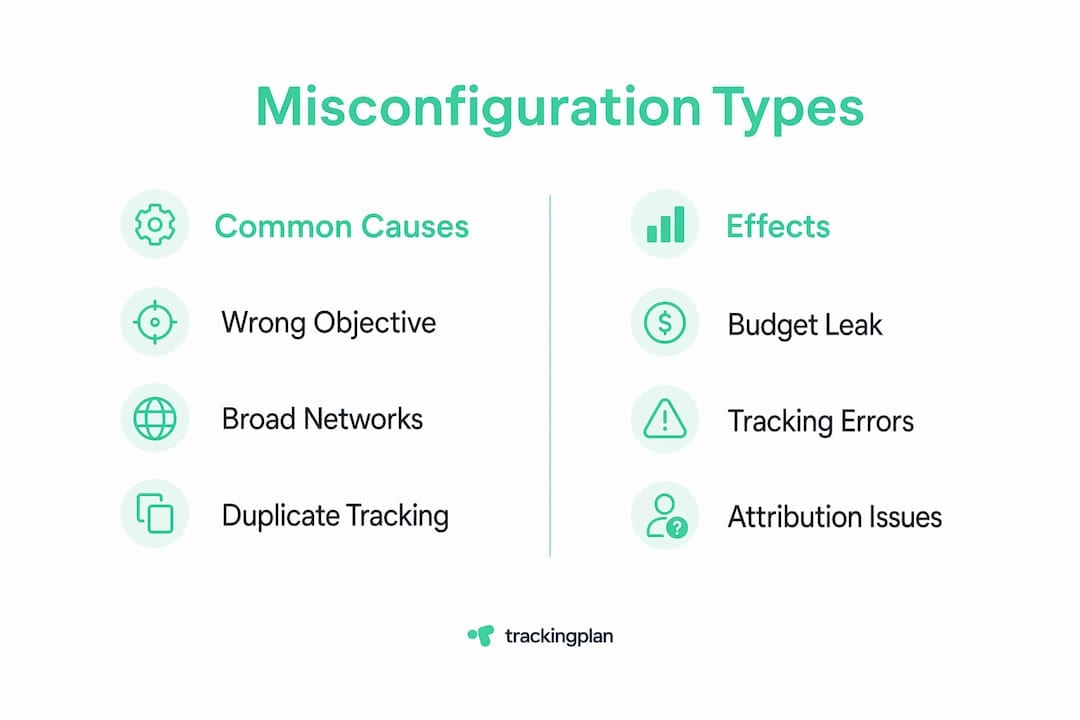
Campaign configuration errors fall into five distinct categories, each with its own failure mode.
- Objective misalignment. Choosing “Traffic” when you need “Conversions” tells Meta or Google to find people who click, not people who buy. The algorithm delivers exactly what you asked for and your cost per acquisition explodes.
- Budget mismanagement. Meta’s CBO requires a minimum of roughly 50 conversion events per week to allocate budget intelligently. Without that volume, CBO routes spend to Audience Network placements that generate cheap impressions and zero quality leads.
- Conversion tracking errors. Duplicate pixel firing artificially lowers your reported CPA, making a losing campaign look profitable. Inconsistent UTM parameters break pipeline attribution inside your CRM, so you cannot tell which campaigns actually drive revenue.
- Audience targeting mistakes. Overlapping ad sets split budget and confuse the algorithm. Missing exclusions mean you retarget existing customers with acquisition offers, wasting spend on people who already converted.
- Placement and network errors. Enabling Google’s Display Network or Search Partners without intent filters sends budget to low-quality inventory. One pharmaceutical case study shows a campaign accruing zero impressions on the primary search channel because the entire budget migrated to Display.
Pro Tip: Before launching any campaign, audit your conversion objective, budget allocation method, and placement settings as three separate checklist items. Treating them as one “setup step” is how errors compound.
Platform defaults prioritize broad reach over conversion efficiency. Automatic placements and broad match without exclusions are factory settings designed for scale, not for service businesses with tight margins. You must override them manually.
How do misconfigurations break tracking and attribution?
Broken attribution is the most expensive downstream consequence of campaign configuration errors. When your tracking layer is corrupted, every optimization decision you make is based on false data.
The three most common technical failures work like this:
- Duplicate conversion firing. A pixel fires on both the page load and a button click for the same purchase event. Your CPA drops by half on paper. You scale the campaign. You are actually scaling a lie.
- Inconsistent UTM parameters. A URL tagged
utm_source=facebookin one ad set andutm_source=metain another creates two separate traffic sources in Google Analytics 4 or your CRM. Your conversion tracking setup fragments, and you cannot accurately attribute revenue to either. - CRM pipeline mismatches. Faulty event tagging means leads enter your CRM without the campaign data attached. Sales teams cannot see which ad drove the lead. Marketing cannot close the loop on ROI.
Duplicate conversion tracking is a documented, fixable problem, but it requires a systematic audit rather than a spot check. The fix is a centralized conversion registry: a single source of truth that maps every event name, trigger condition, and platform destination. Without it, different team members deploy conflicting tags and the data diverges silently.
Pro Tip: Run a conversion tracking validation audit before every major campaign launch. Check for duplicate events, verify UTM consistency across all ad variations, and confirm that your Conversion API (CAPI) events match your pixel events within a 5% tolerance.
Inconsistent UTMs break pipeline attribution in CRM systems and create ghost traffic sources that inflate direct or organic numbers. Standardized naming conventions are not a nice-to-have. They are the foundation of any reliable attribution model.
Budget leaks, learning phase resets, and placement errors compared
These three misconfiguration scenarios cause different types of damage and require different fixes. Understanding the distinction helps you prioritize.
| Misconfiguration Type | Primary Damage | Key Trigger | Fix |
|---|---|---|---|
| Budget leak via CBO | Spend on low-quality placements | Insufficient conversion volume | Manual placement exclusions, ABO for small budgets |
| Learning phase reset | Algorithm loses optimization progress | Edits greater than 20–25% to budget or audience | Stable editing windows, minimal mid-flight changes |
| Placement/network error | Zero impressions on target channel | Default network settings enabled | Manual network selection at campaign creation |
| Duplicate conversion firing | Artificially low CPA, false scaling signals | Multiple tags on same event | Centralized tag registry, deduplication logic |
Avoiding edits greater than 20–25% during a campaign’s active learning phase prevents perpetual resets that block the algorithm from ever reaching stable performance. This is one of the most common errors made by marketers who interpret “optimization” as constant tinkering.
Budget fragmentation across many small ad sets is a structural error that prevents any single ad set from accumulating the event volume needed to exit the learning phase. Consolidating ad sets is often more effective than increasing total budget.
Manual ad launching errors such as decimal mistakes in budget fields, wrong currency settings, and overlapping geographic targets create waste that is invisible until you run a detailed cost analysis. These are process failures, not platform failures.
How to fix campaign misconfigurations: a practical checklist
Fixing campaign configuration errors requires process discipline, not just technical knowledge. Here is a structured approach.
- Build a centralized conversion registry. Document every conversion event by name, platform, trigger condition, and owner. This single step prevents the majority of duplicate firing and naming inconsistency issues.
- Enforce standardized UTM naming conventions. Use a shared UTM builder (Google’s Campaign URL Builder works fine) and lock down the allowed values for
utm_source,utm_medium, andutm_campaign. Deviations from the standard break attribution. - Set stable editing windows. Commit to reviewing campaign performance on a fixed schedule, such as every seven days, and limit budget or audience changes to under 20% per edit. This protects the learning phase.
- Apply manual placement controls for small budgets. If your weekly conversion volume is below 50 events, disable CBO and use Ad Set Budget Optimization (ABO) with explicit placement exclusions. Audience Network and Display Network should be off by default for direct response campaigns.
- Implement rule-based automation for threshold monitoring. Set automated rules in Google Ads or Meta Ads Manager to pause campaigns if CPA exceeds a defined threshold or if impressions drop to zero. This catches silent failures before they drain budget.
- Adopt release governance for tracking changes. Treat every tracking update like a software deployment. Document the change, test in a staging environment, and maintain a rollback plan. Centralized documentation and change controls reduce cascading telemetry errors and keep campaign health stable.
Successful teams maintain conversion registries and enforce naming conventions as standard operating procedure. Teams that skip this step spend disproportionate time in reactive troubleshooting rather than proactive optimization.
Pro Tip: Use a multichannel conversion tracking guide to map every touchpoint before you build your tagging plan. Retrofitting tracking after launch is five times harder than designing it correctly upfront.
Key takeaways
Campaign misconfiguration is a structural process failure, and fixing it requires governance, standardized naming, and systematic audits rather than one-off troubleshooting.
| Point | Details |
|---|---|
| Definition matters | Campaign misconfiguration is a setup error that causes platforms to optimize for the wrong signals, not a creative or audience problem. |
| Five core error types | Objective misalignment, budget mismanagement, tracking errors, audience mistakes, and placement errors each require a distinct fix. |
| Attribution breaks silently | Duplicate conversion firing and inconsistent UTMs corrupt your data without visible alerts, making audits non-negotiable. |
| Learning phase protection | Limit campaign edits to under 20–25% changes and use stable editing windows to prevent algorithm resets. |
| Governance is the fix | Centralized conversion registries, naming conventions, and rollback plans prevent the majority of recurring misconfigurations. |
The configuration problem nobody wants to admit
After years of working with digital marketing teams, the pattern I keep seeing is this: marketers treat campaign setup as a one-time task and campaign optimization as the real work. That framing is backwards.
Configuration is where most performance problems originate. When a campaign underperforms, the first instinct is to swap the creative or tighten the audience. Those are visible levers. A misconfigured objective or a duplicate pixel event is invisible unless you go looking for it. I have watched teams run A/B tests on ad copy for weeks while a duplicate conversion tag was making every variant look like a winner.
The deeper issue is cultural. Engineering teams deploy code with version control, staging environments, and rollback plans. Marketing teams launch campaigns with a checklist that lives in someone’s head. Campaign misconfigurations reflect process failure requiring governance similar to software releases. That framing is not an exaggeration. It is the only mental model that actually prevents these errors at scale.
The teams I have seen get this right share one habit: they document every configuration decision at launch and review it before making any change. That documentation is not bureaucracy. It is the difference between a campaign that compounds performance over time and one that resets its own learning phase every two weeks.
— David
Catch misconfigurations before they cost you
Campaign configuration errors are hard to spot manually, especially across multiple clients, platforms, and tracking implementations. Trackingplan automates the detection layer so you do not have to.
Trackingplan monitors your web tracking setup in real time, flagging duplicate conversion events, broken pixels, schema mismatches, and UTM inconsistencies the moment they appear. Its digital analytics quality tools give marketing teams and analysts a live view of their entire Martech stack, with AI-powered alerts delivered via Slack, email, or Teams. If you are currently relying on manual audits or native platform alerts, Trackingplan closes the gaps those tools miss.
FAQ
What is campaign misconfiguration in digital advertising?
Campaign misconfiguration is an incorrect setup or architectural error in a digital ad campaign that causes the platform to optimize for the wrong signals. The result is poor delivery, wasted budget, and unreliable measurement data.
What are the most common examples of campaign misconfiguration?
Common examples include choosing the wrong campaign objective, enabling broad networks without exclusions, duplicate conversion pixel firing, inconsistent UTM parameters, and overlapping audience targeting. Each of these causes a different type of performance or attribution failure.
How does a misconfigured campaign affect attribution?
Duplicate conversion events artificially lower reported CPA, and inconsistent UTMs fragment traffic sources inside your CRM. Both errors make campaigns appear more profitable than they are, leading to incorrect scaling decisions.
How do i fix a campaign misconfiguration?
Start with a conversion registry audit to identify duplicate or misfiring events, then standardize UTM naming conventions across all active campaigns. Limit mid-flight edits to under 20–25% to protect the learning phase, and apply manual placement exclusions for low-volume campaigns.
Does meta CBO work for small budgets?
Meta’s CBO requires approximately 50 conversion events per week to allocate budget effectively. Below that threshold, CBO routes spend to low-quality placements like Audience Network, producing poor conversion quality and budget waste.