
TL;DR:
- Automated data audits detect up to 90% of errors in real time, reducing revenue leakage.
- They outperform manual reviews by providing full data coverage and faster error detection.
- Hybrid models combining automation with human judgment best ensure accurate, compliant marketing insights.
Tracking errors are costing enterprises far more than most analytics teams realize. 55% of enterprise sites have broken pixels right now, silently bleeding conversion data and skewing attribution models that drive budget decisions worth millions. When your marketing data is wrong, every downstream decision compounds that error. Automated data audits flip this dynamic by replacing slow, sample-based manual reviews with continuous, AI-powered monitoring across your entire data ecosystem. This article walks through what makes an automated audit effective, how it compares to manual methods, what real marketing teams gain from it, and where hybrid models still make sense.
Table of Contents
- Criteria for effective automated data audits
- How automated data audits outperform manual audits
- Real-world benefits for digital marketing teams
- Limitations and hybrid audit models
- Our take: Automation is pivotal, but context matters
- Connect automation to your analytics stack
- Frequently asked questions
Key Takeaways
| Point | Details |
|---|---|
| Higher error detection | Automated audits identify significantly more tracking errors than manual methods, reducing costly data leaks. |
| Time and resource savings | Automation frees analytic teams to focus on strategy by cutting validation workload by up to 85%. |
| Hybrid models ensure accuracy | Mixing automated and manual audits catches nuanced errors and delivers comprehensive data quality coverage. |
| ROI and conversion boosts | Reliable audit routines drive up to 300% conversion improvements and reduce annual losses. |
Criteria for effective automated data audits
Before evaluating any tool or process, your team needs a clear framework for what a quality automated audit actually looks like. Not all automation is equal, and choosing based on surface features rather than core methodology is how teams end up with dashboards full of noise and no real signal.
The most rigorous automated audit systems continuously monitor five core data quality dimensions: completeness (are all expected events firing?), freshness (are events arriving on schedule?), volume (are traffic levels within normal ranges?), schema consistency (do event structures match defined specs?), and distribution stability (are value patterns behaving normally?). Monitoring all five simultaneously gives you a layered safety net, not just a single trip wire.
Here is what separates a genuinely effective automated audit from a basic alert system:
- Continuous QA pipelines that validate every event in real time, not just during scheduled batch runs
- Schema validation against a predefined tracking plan, so drift is caught at the source before it corrupts reporting
- AI-powered anomaly detection that learns your baseline and flags deviations without flooding your team with false alarms
- Coverage across environments, including web, mobile apps, and server-side implementations
- Root-cause analysis that not only flags an issue but traces it back to a specific tag, release, or configuration change
A solid digital marketing audit checklist helps structure what to look for across each of these dimensions during setup and ongoing review cycles. Pairing that with data monitoring best practices ensures your configuration stays aligned with how your data actually behaves over time.
Pro Tip: Start your automation rollout by prioritizing tracking for your highest-value campaigns and conversion events. This delivers the fastest return on investment and builds internal confidence before you expand coverage to lower-priority properties.
How automated data audits outperform manual audits
Once you know what to look for, the next question is whether automation genuinely delivers better results than a skilled analyst doing it manually. The evidence is not subtle.
Automated audits detect up to 90% of tracking errors in real time, compared to just 30 to 50% for manual audits. That gap translates directly into revenue leakage of 15 to 20% at enterprise scale. Manual audits, no matter how thorough, rely on sampling. A human reviewer simply cannot check every event, every session, across every property, every hour of every day.
| Dimension | Automated audits | Manual audits |
|---|---|---|
| Data coverage | 100% of events | Sample-based (5 to 15%) |
| Error detection rate | Up to 90% | 30 to 50% |
| Detection speed | Real time | Days to weeks |
| Analyst time required | Minimal (alert-driven) | High (ongoing review) |
| Revenue leakage prevention | 15 to 20% | Limited |
Beyond detection rates, the operational impact is significant. Automation reduces manual audit time by 80 to 85%, which means your analytics team can redirect that reclaimed time toward strategic analysis, model refinement, and campaign optimization rather than tedious validation work.
“The real value of automated audits isn’t just catching errors faster. It’s converting the time your team used to spend validating data into time spent acting on it.”
For teams detecting tracking issues across complex tag structures or multi-property environments, the scale advantage of automation is practically impossible to replicate manually. A missed pixel on a single landing page during a high-spend campaign can invalidate weeks of attribution data. Automation catches that the moment it happens.
Real-world benefits for digital marketing teams
Theory aside, what do marketing teams actually gain when they operationalize automated audits? The outcomes are measurable and, in many cases, dramatic.
Empirical data shows that fixing tracking issues through audits drives conversion improvements ranging from 30% to 300%, depending on the severity of the original problem. A retailer with a broken checkout pixel, for example, might be attributing zero conversions to a channel that’s actually performing well. Fixing that single issue can completely reshape budget allocation.

Here’s a summary of quantified benefits seen in enterprise environments:
| Benefit area | Typical impact |
|---|---|
| Conversion rate improvement | 30 to 300% after fixing tracking errors |
| Annual cost of poor data quality | $12.9M per Gartner |
| Broken pixel prevalence | 55% of enterprise sites |
| Data coverage vs. manual | 100% automated vs. sampling |
Poor data quality costs enterprises an average of $12.9M annually, according to Gartner. That’s not just a technology problem. It’s a business risk that belongs in board-level conversations. If you’re building the case internally, resources on pitching data quality to leadership can help frame the financial exposure clearly.
Beyond the numbers, here is where marketing teams feel the clearest operational improvements:
- Attribution accuracy: Clean tracking means your multi-touch models reflect what channels are actually driving value, not what a broken pixel allowed you to see
- Campaign optimization speed: When you trust your data, you can make bid and budget decisions faster without double-checking every number
- Compliance confidence: Automated cookie audits catch consent and privacy gaps before they become regulatory exposure
- Cross-team alignment: Shared, verified data reduces the endless debates between marketing and analytics over which numbers are right
Limitations and hybrid audit models
Automation is powerful, but treating it as a complete replacement for human judgment creates its own risks. There are specific scenarios where automation consistently falls short, and knowing these gaps is what separates a mature analytics operation from an overconfident one.
Automation excels at scale but struggles with business context, intermittent failures, consent blocking, cross-device tracking inconsistencies, and false positives. A system can flag that an event volume dropped 40%, but it cannot tell you whether that drop reflects a real problem or a deliberate campaign pause. That judgment belongs to a person.
Here are the five most common automation limitations in enterprise environments:
- Business context gaps: Automated systems don’t know when a traffic drop is intentional, such as budget throttling or a planned site maintenance window
- Intermittent failures: Some errors appear and disappear too quickly for batch-based systems to consistently catch, especially in high-traffic environments
- Consent and privacy edge cases: Consent management platforms interact with tags in ways that require manual review to validate compliance accurately
- Cross-device tracking: Identity resolution across sessions and devices involves logic that AI flags correctly but humans must interpret in context
- False positives: Overly sensitive anomaly thresholds generate noise that erodes team trust in the alert system over time
Manual audits provide contextual understanding and catch strategic misalignments that purely automated systems miss. The expert consensus now points toward hybrid models that combine AI scale with human judgment, not one or the other. A website audit checklist used quarterly by your team alongside continuous automation is a practical implementation of this approach. The automated marketing observability guide offers a useful framework for deciding which tasks to automate versus which to reserve for human review.
Pro Tip: Reserve manual spot-checks specifically for regulatory and privacy edge cases, new consent framework rollouts, and any scenario where a false positive could trigger a significant operational or legal response.
Our take: Automation is pivotal, but context matters
We’ve seen enough enterprise analytics implementations to say this plainly: teams that automate everything and then walk away from the data are not better off than teams that do nothing. They’re just faster at being wrong.
The real shift automation enables is not the elimination of human involvement. It’s the elevation of it. When AI handles the mechanical work of scanning every event against a schema, your analysts have the headroom to ask better questions. Why did this campaign outperform? What changed in user behavior last quarter? Is our attribution model still valid after the iOS privacy changes?
The teams getting the best results from accurate marketing insights are the ones treating automation as infrastructure, not as a decision-maker. They trust the alerts. They investigate the anomalies. And they apply business judgment to every finding before acting on it. That combination, smart tooling plus experienced human oversight, is where enterprise analytics actually becomes competitive.
Connect automation to your analytics stack
You’ve seen the evidence. Automated data audits catch more errors, faster, and at a fraction of the cost of manual review. The next step is connecting that capability to your existing analytics environment.
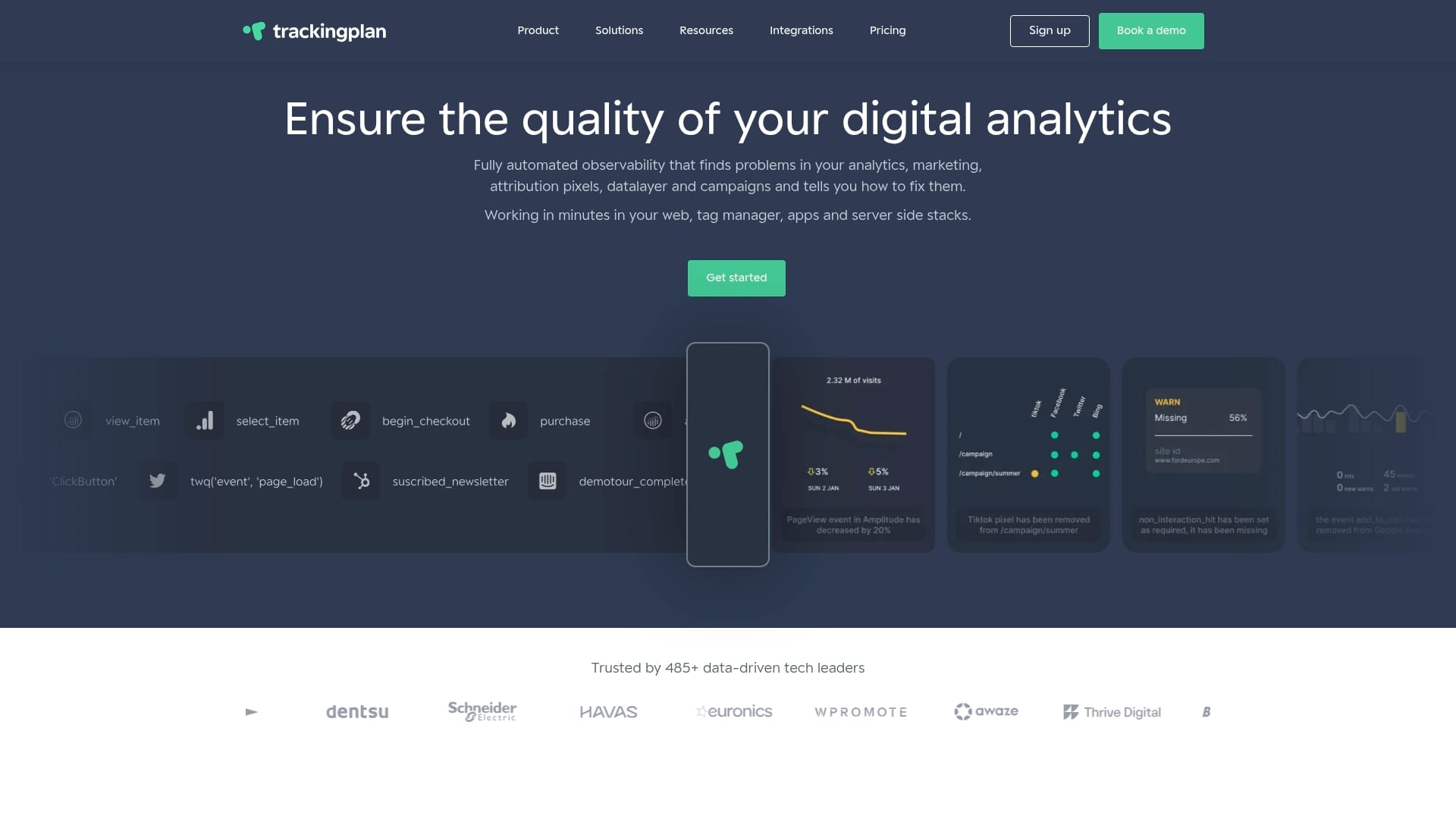
Trackingplan integrates with your digital analytics tools to provide continuous monitoring, real-time alerts, and automated schema validation across web, app, and server-side properties. The AI-assisted debugger goes further, pinpointing the root cause of tracking failures so your team spends minutes fixing issues instead of hours finding them. If your enterprise is serious about protecting the data quality that drives every marketing decision, explore what the Trackingplan platform can do for your analytics stack today.
Frequently asked questions
What are the main advantages of automated data audits for enterprises?
Automated audits detect up to 90% of tracking errors in real time versus 30 to 50% for manual methods, preventing revenue leakage of 15 to 20% and freeing analytics teams to focus on strategy rather than validation.
Does automation replace manual audits entirely?
No. Automation excels at scale but cannot replace human judgment for business context, privacy compliance checks, and validating AI outputs, making hybrid models the recommended approach for enterprise teams.
What data quality dimensions should audits monitor automatically?
Automated audits should continuously track five quality dimensions: completeness, freshness, volume, schema consistency, and distribution stability for maximum detection reliability.
How often should automated audits run for best results?
Continuous automation paired with quarterly manual reviews gives enterprises scalable accuracy while preserving the human oversight needed to validate AI findings and catch strategic misalignments.