
Your automation stack probably already does a lot. It sends emails on schedule, routes leads, updates audiences, and fires alerts when a threshold changes. Then the team asks for something just beyond those rules.
Not a bigger nurture flow. Not another dashboard. Something that can watch behavior, decide what matters, choose the next action, and adapt without waiting for a marketer to rebuild the workflow.
That's where the conversation shifts to AI agents for marketing. And that's also where many teams get into trouble.
The problem usually isn't ambition. It's data trust. An autonomous system working on bad campaign tagging, broken events, mismatched schemas, or missing consent signals doesn't just produce a messy report. It acts on the wrong reality. It can push the wrong segment, optimize toward corrupted conversions, or summarize a competitor move from incomplete inputs.
The teams that get value from AI agents aren't the ones with the loudest pilot. They're the ones with the cleanest signals, the clearest guardrails, and a way to monitor what the agent saw, decided, and did.
The New Era of Autonomous Marketing
A familiar pattern shows up in mature marketing teams. They've built solid automation in HubSpot, Marketo, Salesforce, Braze, or Customer.io. The workflows are organized. The naming conventions are documented. Reporting lands in Looker, Tableau, or Power BI.
Then the team hits the ceiling.
The platform can send a personalized sequence from a known list, but it can't decide which emerging audience deserves budget this week. It can rotate creative, but it can't explain why one cohort suddenly dropped out of the funnel. It can follow the map. It can't redraw it.
That gap is why AI agents for marketing matter. They don't just execute prewritten instructions. They take a goal, inspect context, reason through options, and act across multiple steps.
Where old automation stops
Traditional automation is still useful. It's reliable when the task is repetitive and the logic is known in advance. If a customer submits a form, trigger the email. If a user abandons a cart, launch the reminder. If spend rises beyond a limit, notify the team.
AI agents operate differently. They can evaluate multiple inputs, decide what to do next, and chain tasks together without a person specifying every branch of logic.
Practical rule: Automation follows a workflow. An agent pursues an outcome.
That shift is already moving into budgets and operations. In 2025, the global AI agent market is projected to grow at a 35% compound annual growth rate, while 88% of senior executives plan to increase AI-related budgets in the next 12 months and 79% confirm AI agents are already adopted in their companies, according to this 2025 market overview on agentic AI in marketing.
Why marketers feel the pressure now
A growth team doesn't need a philosophical definition of agentic AI. It needs to know whether this changes campaign operations. It does.
The shift is from tooling that waits for marketer input to systems that can propose, prioritize, and execute. That's why the conversation around AI in digital marketing and smarter tracking has moved beyond content generation and into execution quality.
Here's the catch. The more autonomy you grant, the more expensive your data mistakes become. A broken UTM used to pollute attribution. In an agentic workflow, it can distort decisions downstream.
Understanding AI Marketing Agents
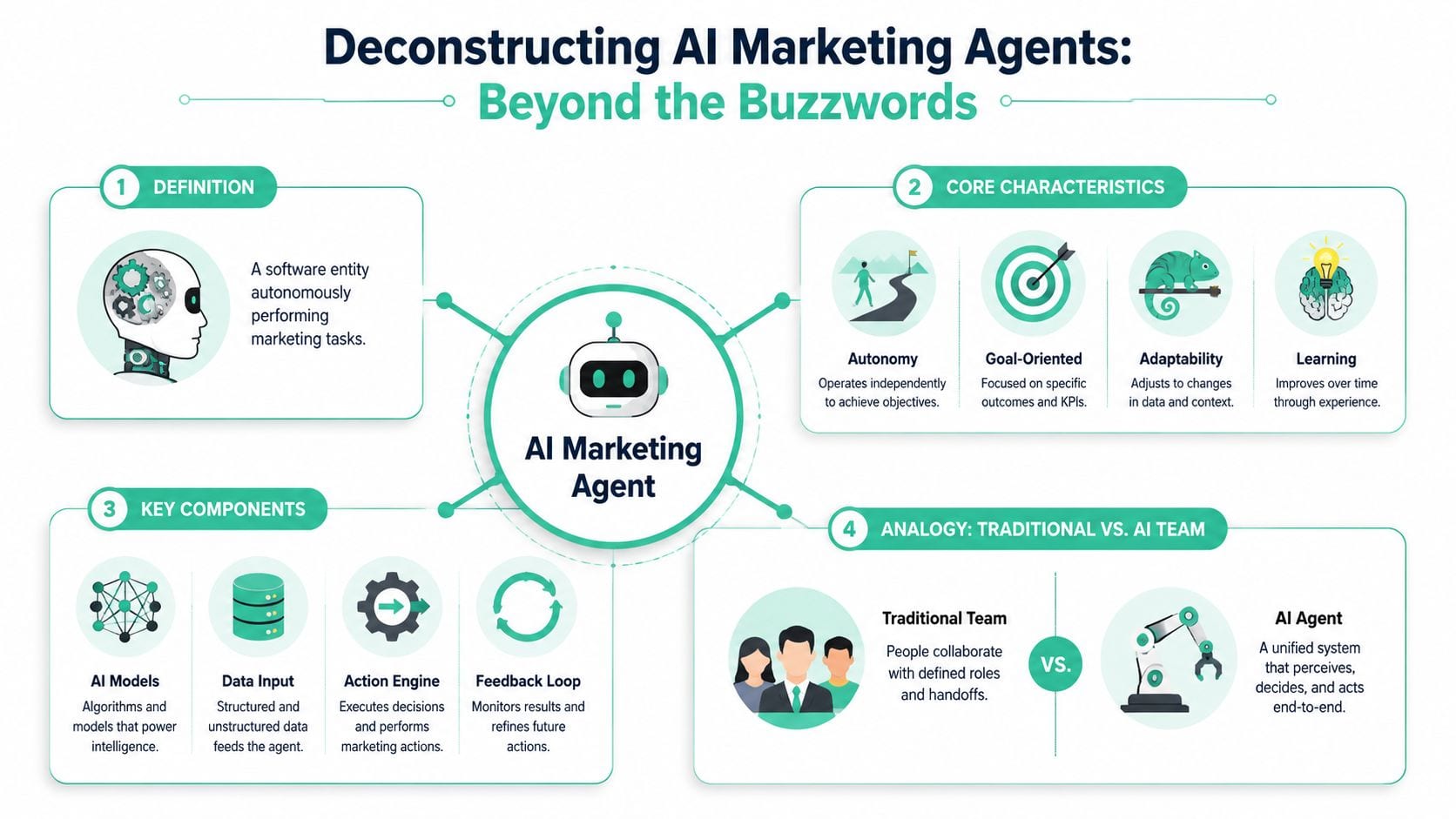
An AI marketing agent is best understood as a software worker with a goal, access to data, and permission to act.
A chatbot answers what it has been prepared to answer. An agent can research, compare, decide, and execute. That's the difference that matters in practice.
What separates an agent from a chatbot
A simple analogy works well. A scripted chatbot is like a support rep reading approved replies. An agent is closer to a junior marketing strategist. Give it a target and constraints, and it can gather inputs, weigh options, and recommend or take next actions.
For example, a support-focused team exploring AI for customer support will quickly notice the line between conversational assistance and true agency. One responds. The other can orchestrate a workflow.
Three characteristics define the category:
- Autonomy: The system acts without needing a person to approve every micro-step.
- Reasoning: It can handle multi-step tasks such as prospecting research, content optimization, or dynamic segmentation, as described in this breakdown of AI agents versus traditional automation layers.
- Goal orientation: It works toward a business objective, not just task completion.
What the stack actually looks like
Under the hood, an AI marketing agent usually depends on a few components working together:
| Component | What it does |
|---|---|
| Model layer | Interprets prompts, data, and context |
| Data inputs | Pulls signals from CRM, analytics, product events, content, and external sources |
| Action layer | Writes, updates, triggers, routes, or publishes |
| Feedback loop | Learns from outcomes and adjusts later decisions |
This category is becoming hard to ignore. As of 2026, the AI agents market is valued at $10.69 billion and is expected to reach $47.1 billion by 2030, with Gartner projecting that 40% of enterprise applications will include task-specific AI agents by the end of 2026, up from less than 5% a year earlier, according to Demand Gen Report's 2026 market analysis.
The practical question isn't whether the category is real. It's whether your data and governance are strong enough for the category to work safely.
AI Agent Capabilities and Marketing Use Cases
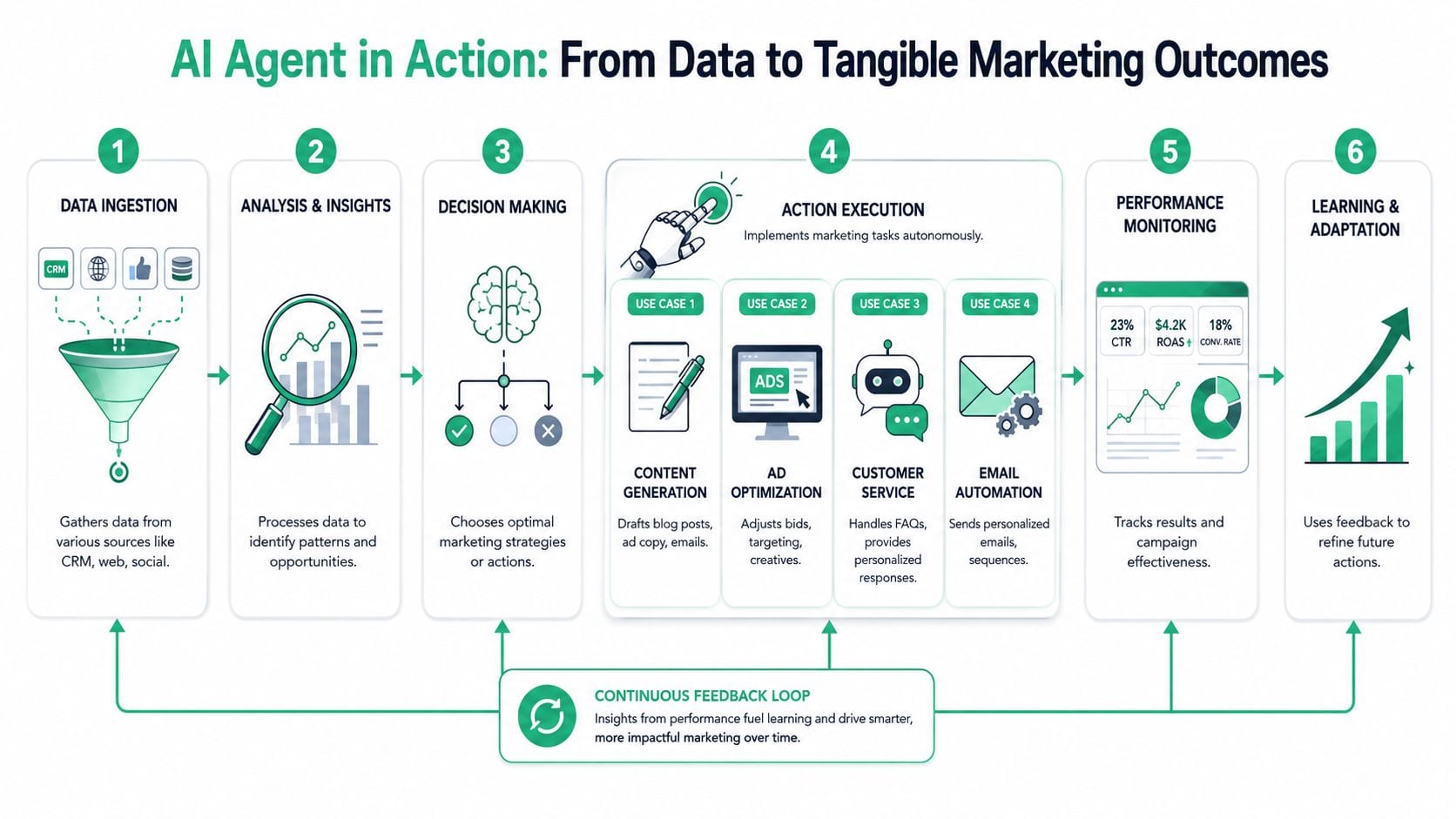
The easiest way to understand AI agents for marketing is to watch the work they replace.
A competitor tracking workflow is a good example. In many teams, someone checks pricing pages, social posts, review sites, newsletters, and press mentions. Then they compile a summary in Slack or email. It's useful work, but it's fragmented and easy to miss.
An agent-driven version can do that continuously. According to DataGrid's overview of automated competitor tracking, the architecture depends on four pieces: automated collection tools for web, social, and news sources; AI agents that handle both structured and unstructured data; machine learning models for pattern recognition; and a synthesis layer that turns findings into dashboards.
Use case one: competitor monitoring that doesn't wait for Monday
A useful agent doesn't just collect competitor updates. It should separate noise from signal.
That means identifying when a pricing page changed in a meaningful way, when a review theme keeps repeating, or when a product launch appears across multiple channels at once. The best implementations don't stop at summaries. They link observations to possible actions such as revising landing page messaging, updating sales battlecards, or flagging a campaign risk.
If the workflow includes scraping public pages, teams also need to think operationally. Some sources block repetitive collection, which is why technical teams often need methods that handle anti-bot systems responsibly when gathering public data at scale.
Use case two: content optimization for AI-mediated discovery
This is the use case many teams still underestimate.
Bain & Company reports that AI agents prefer rich, conversational text like blogs and explainers, and 60% of marketers must now build intelligence to understand how LLMs reshape the customer funnel and how brands appear in AI-powered search engines, as noted in Bain's analysis of marketing's new middleman.
That changes content operations in practical ways:
- Clear definitions matter: Agents retrieve and summarize passages better when pages explain concepts directly.
- Ordered structure matters: Clean headings, lists, and scannable sections help models parse and reassemble information.
- Hidden value props hurt: If the core differentiator is buried deep in a cluttered page, the agent may never surface it.
A lot of classic SEO advice doesn't help here. Keyword repetition won't rescue a page that is hard to scrape, hard to parse, or full of outdated claims. Teams already using anomaly detection in marketing operations will recognize the pattern. Weak structure creates weak downstream signals.
Use case three: multi-step marketing execution
Agents can also run workflows that combine research, drafting, segmentation, and distribution. A system might review campaign performance, identify an underperforming segment, draft a revised message, and prepare an updated test plan.
That said, not every marketing task should be handed to an agent.
Give agents tasks with clear signals, bounded actions, and measurable outcomes. Keep brand positioning, strategic trade-offs, and high-stakes decisions under human review.
Building the Data Foundation for AI Agents
At 9:00 a.m., the dashboard says paid social is efficient. By noon, an agent has shifted budget toward the wrong audience because a checkout event changed overnight and no one caught it. That is how AI agent failures usually start. Not with model quality, but with broken inputs, missing fields, and silent tracking drift.
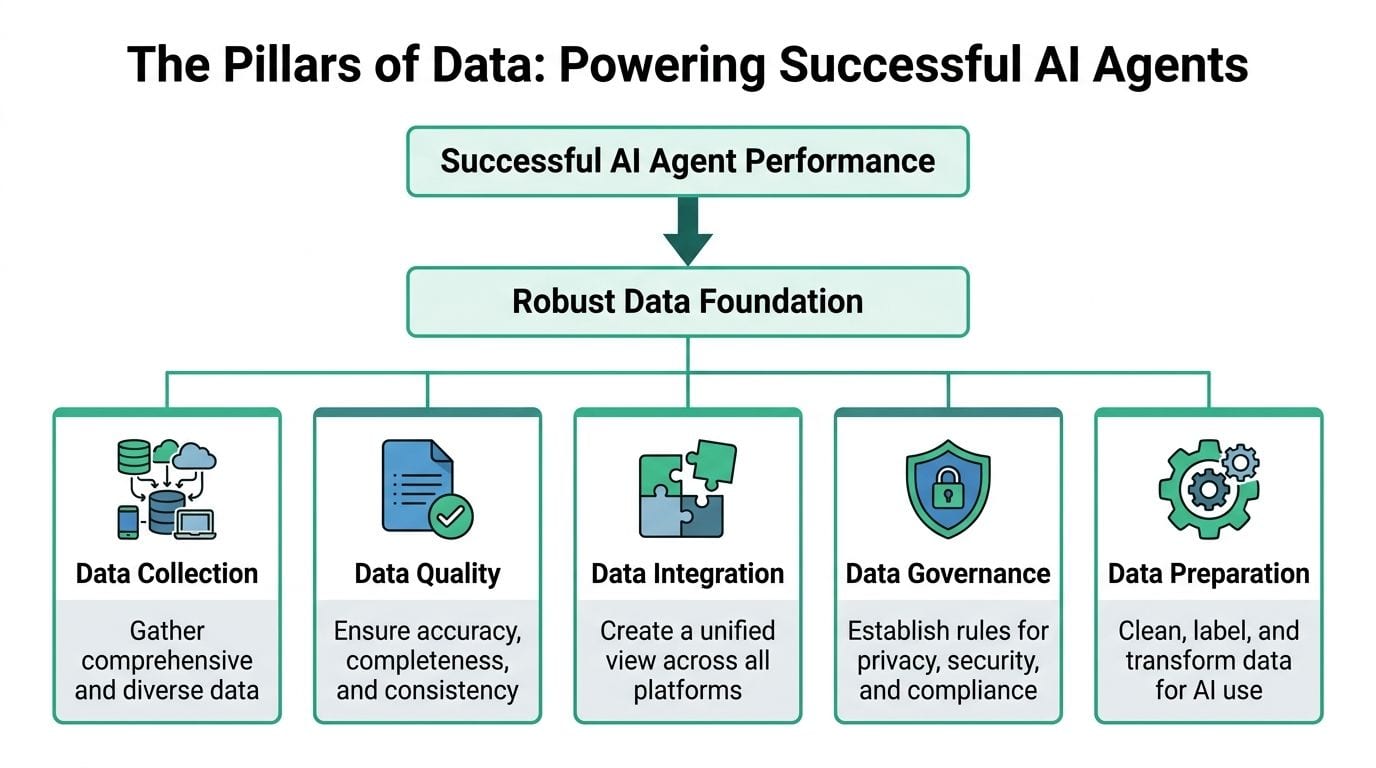
Agents need more than access to data. They need data they can trust enough to act on without constant human correction. For marketing teams, that usually comes down to four things: unified customer profiles with identity resolution, fresh behavioral event streams, historical performance data that has been validated, and consent signals that are applied correctly. CDP.com's guide to AI marketing agent requirements outlines that baseline well.
Each part supports a different decision layer.
- Unified customer profiles: If one buyer appears as three users across devices, the agent fragments audiences, frequency, and attribution.
- Fresh behavioral streams: Delayed events push the agent to optimize against yesterday's reality.
- Validated historical performance: Bad history trains bad judgment. The model will repeat tracking mistakes as if they were customer patterns.
- Consent signals: If permission status is wrong, the problem is not just poor targeting. It becomes legal and reputational risk.
This is the part many teams underestimate. Autonomous systems increase the cost of small data defects. A mislabeled campaign, a dropped property in the mobile app, a server-side destination that stops firing for one browser, or a taxonomy change that never reaches reporting logic can all trigger the wrong action at scale.
Here's a useful explainer from the analytics QA side:
Bad data turns a tracking issue into an execution issue.
In practice, the safest setup is not “more AI.” It is tighter verification around the inputs the agent reads and the actions it is allowed to take. That means monitoring event coverage, schema changes, naming consistency, consent propagation, and destination delivery before errors reach campaign logic.
Public data collection creates another weak point. Teams using external web data for research, pricing checks, competitor monitoring, or enrichment also need controls for scraper failures, layout changes, and blocked requests. If your pipelines depend on pages that actively handle anti-bot systems, consistency can break fast unless collection quality is monitored like any other production input.
Governance matters here because agents collapse the distance between analysis and action. Clear ownership, approval rules, and validation checks keep one bad feed from becoming a chain of bad decisions. If your standards are still loose, start with these data governance best practices for modern marketing stacks before you automate campaign decisions.
Your AI Agent Implementation and Governance Plan
The wrong way to implement an agent is to start with the most ambitious workflow and hope the model figures it out.
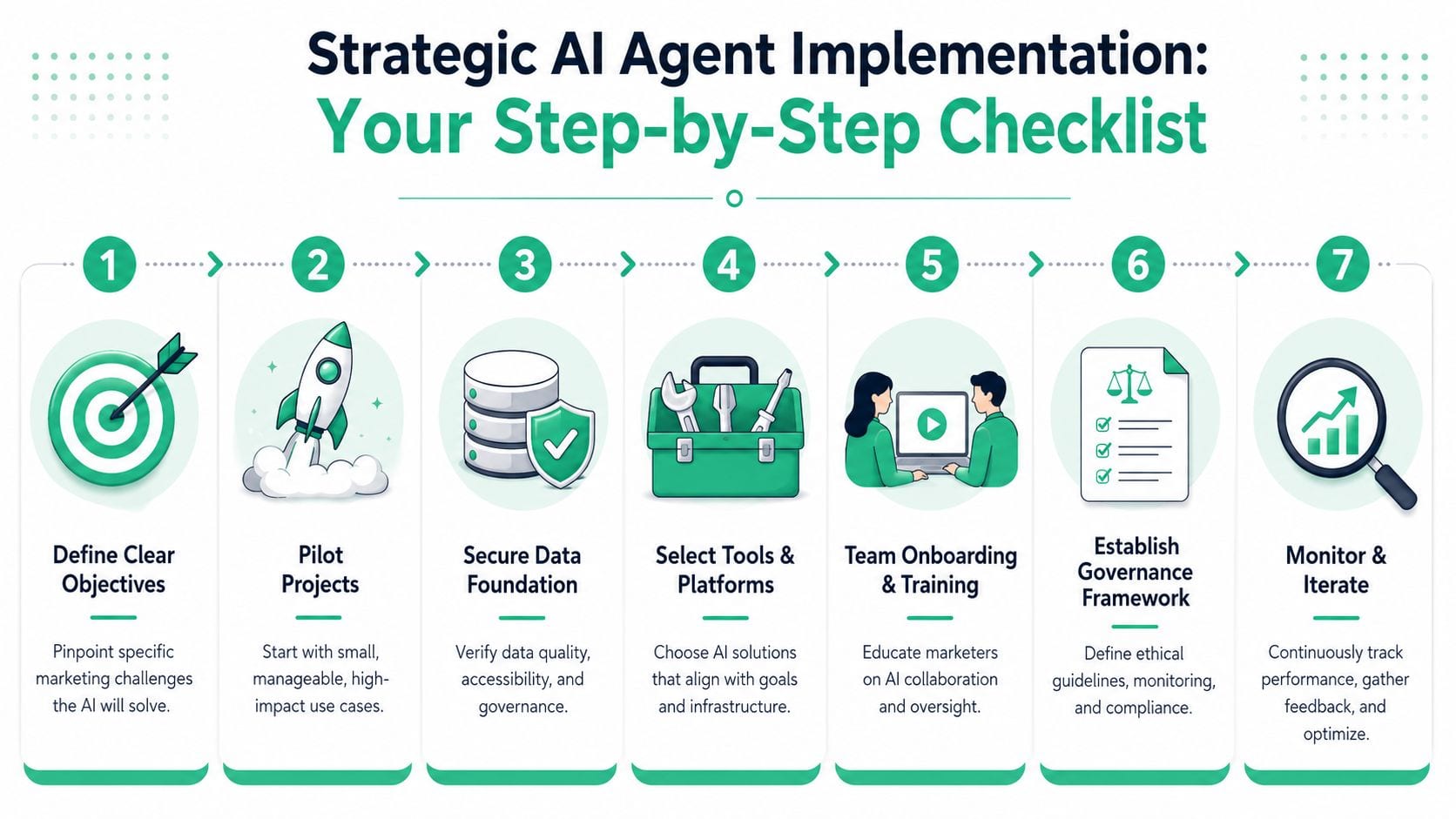
The right way is smaller and more disciplined. Pick a bounded use case, define what success and failure look like, and instrument every step. Governance belongs at the start, not after the pilot.
Start with a narrow job
Good early candidates include competitor summaries, campaign QA support, content brief generation, or audience research. These are useful, but they don't immediately place budget allocation or customer communications on full autopilot.
A practical implementation plan usually looks like this:
- Define the business outcome. “Improve paid social” is too vague. “Flag campaign tagging issues before launch” is workable.
- Limit the action space. Decide what the agent may read, write, trigger, or update.
- Set review thresholds. Some outputs can publish automatically. Others need approval.
- Create failure handling. If confidence is low or data is missing, the system should stop or escalate.
Instrument the agent like a critical system
Many projects frequently remain immature.
For effective AI agent monitoring, teams need to treat the agent as any critical system by emitting a structured event record for every step it takes, including actions, tool calls, outputs, and outcomes, as described in Monte Carlo's guide to AI agent monitoring.
That principle matters because debugging an agent after the fact is hard if you can't reconstruct the chain. You need to know:
- What input it received
- Which tools it called
- What intermediate reasoning or outputs were generated
- What action it finally took
- What happened next
The data side is just as important. The full power of AI agents comes only when fueled by “clean, connected, and permissioned data,” yet corrupted inputs can lead to flawed autonomous decisions. Without automated observability, agents can amplify broken UTMs, schema mismatches, or missing pixels, as explained in LiveRamp's perspective on preparing marketing data for agentic AI.
Keep humans where they add judgment
The human role doesn't disappear. It changes.
Use people for trade-offs, brand protection, exception handling, and escalation. Let the agent handle repetitive inspection, first-pass synthesis, and constrained execution. The more expensive the decision, the more valuable human skepticism becomes.
That skepticism isn't optional. Benchmarking of state-of-the-art AI agents found 67.4% accuracy in tool-augmented, adversarial financial and marketing decision tasks, below the 80% baseline of junior human analysts, according to this arXiv benchmarking study on agent reliability. Tool access alone doesn't make judgment reliable.
Measuring ROI and Avoiding Common Pitfalls
Once the pilot is live, teams usually ask the wrong ROI question. They ask whether the agent is impressive.
That's not the test. The key question is whether it improves economics or execution quality in a way the business can verify.
Measure two kinds of return
The cleanest way to evaluate AI agents for marketing is to separate efficiency gains from performance gains.
Efficiency gains show up in operating work:
- Research time reduced: Less manual collection and summarization
- QA effort reduced: Fewer hours spent finding broken tags, missing events, or bad routing
- Faster cycle times: Briefs, alerts, and optimizations happen sooner
Performance gains show up in outcomes:
- Better targeting quality
- Cleaner campaign execution
- More reliable attribution for decision-making
- Fewer preventable reporting errors
If your team needs a tighter framework for the business side, measuring marketing effectiveness is the right lens. It keeps the conversation anchored in trusted outcomes, not novelty.
The mistakes that keep repeating
A few pitfalls show up again and again:
- Vague objectives: If the goal is broad, the agent will produce broad output that no one can judge well.
- Weak input controls: Teams approve the model before validating the event stream, consent layer, or naming conventions.
- No human escalation path: When the system encounters ambiguity, it still needs a safe default.
- Treating output as truth: Generated confidence is not the same as verified correctness.
The fastest way to lose trust in an AI agent is to let it operate on data the team already knows is inconsistent.
There's also a strategic mistake. Some teams expect the agent to create a marketing strategy from scratch. That's usually the wrong job. Agents are strongest when the team already understands the business objective and needs help executing, monitoring, or adapting around it.
Your Next Steps with AI Marketing Agents
The value of AI agents for marketing doesn't come from autonomy alone. It comes from autonomy paired with clean inputs, clear constraints, and continuous observability.
That's the part many teams skip because it feels less exciting than prompting, orchestration, or model selection. But readiness beats hype. If the data layer is unstable, the agent will only automate instability.
Three practical next steps are enough to get started:
- Audit your analytics and data quality. Check event consistency, schema integrity, campaign tagging, consent logic, and destination coverage.
- Choose one narrow pilot. Pick a workflow with clear boundaries and visible business value.
- Implement automated observability before expanding autonomy. If you can't see data defects and agent actions early, you'll find them late.
If your team is also evaluating the build-versus-buy question, firms focused on AI agent development can be useful for scoping orchestration, workflow design, and integration patterns. Just make sure the architecture conversation includes data validation and governance from day one.
The teams that win with agentic marketing won't be the ones that moved fastest into autonomy. They'll be the ones that made their data dependable enough to trust what autonomy does.
If your team wants a safer path to AI-driven marketing operations, Trackingplan helps you establish the trust layer first. It automatically monitors analytics implementations, detects broken UTMs, schema mismatches, missing pixels, consent issues, and other data problems before they distort reporting or feed bad inputs into autonomous systems. That gives marketers, analysts, and engineers a cleaner foundation for using AI with confidence.