
Most advice on how to persuade starts in the wrong place. It tells you to sharpen your message, project confidence, use social proof, and handle objections better. That advice matters, but it misses the failure point that ruins more pitches, experiments, and budget requests than weak copy ever does.
Your audience often isn't rejecting your idea. They're rejecting the reliability of the evidence behind it.
In digital teams, persuasion breaks when dashboards conflict, attribution looks unstable, event tracking is incomplete, or nobody can explain why one report says growth while another says decline. That skepticism spreads fast. Once a stakeholder doubts the instrumentation, every recommendation starts sounding like interpretation rather than proof.
The gap is larger than most persuasion guides admit. 78% of marketing leaders report that data quality issues cause them to lose stakeholder buy-in according to this AMA article on persuasive communication. That single fact should change how marketers and analysts think about persuasion. If the numbers aren't trusted, the rhetoric doesn't matter.
Good persuasion still depends on understanding people. It also depends on understanding what those people can verify. In practice, that means pairing behavioral psychology with disciplined research, clean instrumentation, and evidence your audience can inspect without flinching. Teams that already use structured discovery practices such as user research methods often recognize this faster, because they know persuasion improves when you ground claims in what users did and said, not just what a slide deck implies.
The Real Reason Your Persuasive Arguments Fail
A polished argument can survive disagreement. It rarely survives suspected bad data.
Marketing and product teams usually assume resistance comes from poor messaging. So they rewrite the narrative, add another benchmark slide, or make the CTA more assertive. Meanwhile, a deeper problem sits lower in the stack. A broken pixel, inconsistent naming convention, missing signup event, or consent setup that suppresses part of the funnel can undermine confidence before the conversation even starts.
Trust breaks before logic does
Stakeholders don't need to be analytics specialists to sense when something is off. They notice when conversion totals change after a dashboard refresh. They notice when paid traffic reports don't line up with CRM outcomes. They notice when one team cites GA4, another cites Shopify, and finance trusts neither.
Practical rule: If your audience has to wonder whether the measurement is wrong, they stop evaluating the recommendation on its merits.
That is why some teams keep losing decisions even when their reasoning is sound. The room isn't debating the strategy. The room is debating whether the evidence is safe to use.
Classical persuasion advice misses digital reality
Traditional persuasion frameworks focus on authority, reciprocity, commitment, and framing. Those still work. But digital organizations added a new prerequisite. Your claim has to be measurable, and your measurement has to be believable.
A few common examples:
- Campaign reviews fail when the team can't prove whether a drop came from channel performance or tracking loss.
- Product recommendations stall when event definitions changed midway through the quarter.
- Budget requests get challenged when attribution logic isn't documented well enough to survive scrutiny.
- Experiment wins get ignored when analysts can't rule out implementation errors.
The practical lesson is simple. Before you try to persuade with insight, make sure you're not asking people to trust a broken mirror.
Persuasion starts earlier than the presentation
The strongest persuasive teams don't just prepare better slides. They prepare better evidence. They align definitions early, validate instrumentation before launch, and reduce the number of places where a stakeholder can reasonably say, "I'm not sure I trust that."
That isn't a technical side quest. It's the first layer of persuasion.
Understanding the Core Principles of Persuasion
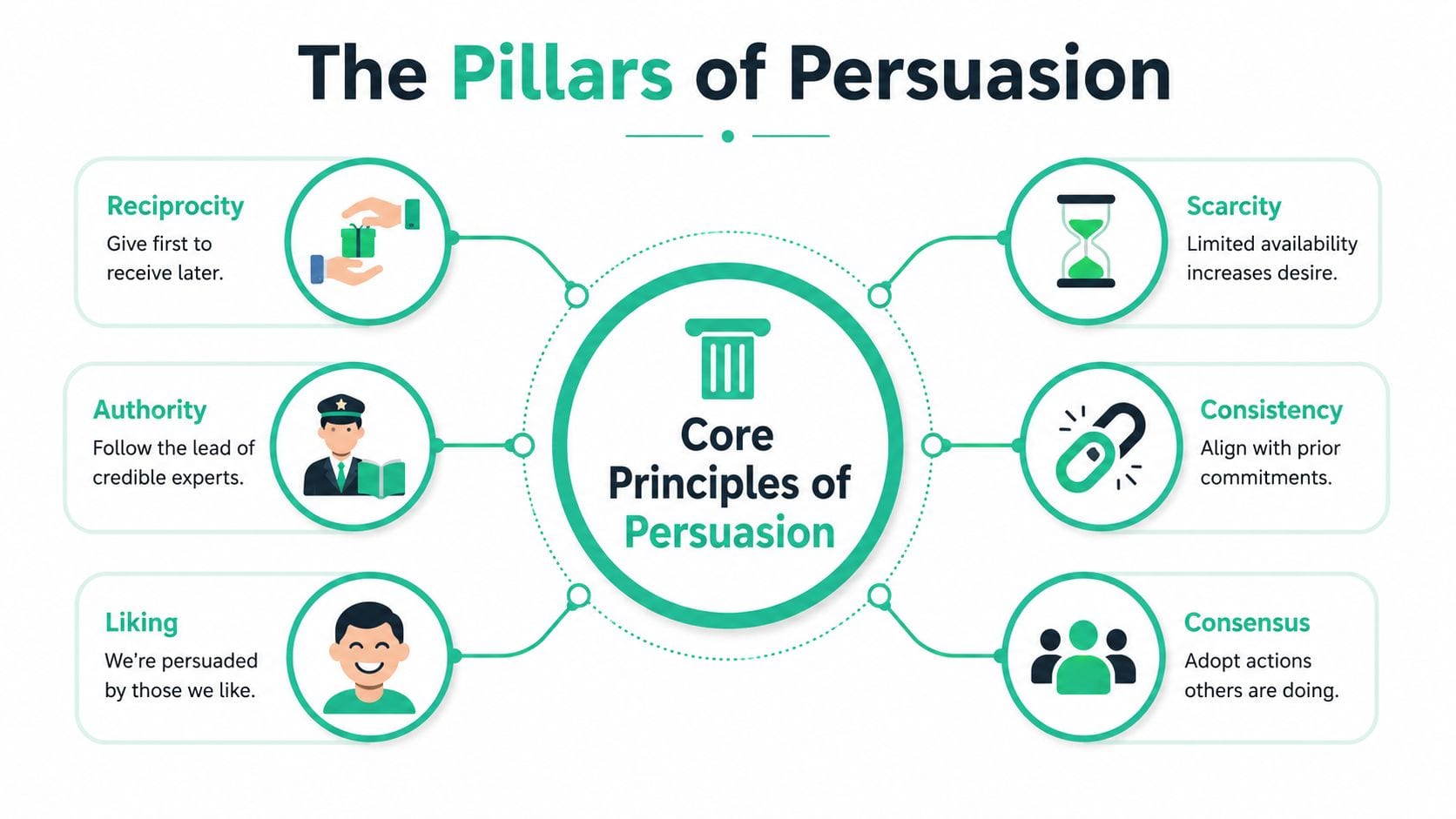
Persuasion still runs on human psychology. People don't make decisions in a vacuum, and they rarely respond to raw information alone. They respond to cues about risk, trust, familiarity, effort, and social acceptance. If you want to learn how to persuade effectively, you need to know which mechanism you're activating and why it works.
Reciprocity and authority
Reciprocity is straightforward. When a brand, analyst, or product experience gives someone useful value first, the next request feels more reasonable. That value can be a calculator, a teardown, a benchmark template, or a helpful onboarding flow. Reciprocity fails when the "gift" is obviously bait.
Authority works when expertise is visible and credible. In marketing, that might mean showing a thoughtful methodology, not just claiming expertise. In analytics, it means documenting event logic, naming assumptions, and being precise about what the data can and can't support. Real authority reduces uncertainty. Fake authority adds jargon.
A useful content exercise is to audit the numbers you present and the measures you prioritize. Teams that care about metrics for content marketing usually get better at persuasion because they stop relying on vanity indicators and start tying claims to outcomes people value.
Scarcity, liking, and consensus
Scarcity increases attention because limited availability raises the perceived cost of waiting. It works best when the limitation is real. If every webinar is "last chance" and every pricing page says "ending soon," people learn not to believe you.
Liking matters more than many analytical teams admit. People are more open to persuasion when the communicator sounds clear, fair, and aligned with their goals. In practice, this means your recommendation should feel collaborative rather than self-congratulatory.
Consensus shows people what others are already doing. That doesn't mean slapping on a logo bar and calling it social proof. Strong consensus is specific. It shows recognizable behavior, real adoption patterns, or a practical norm that helps people decide with less friction.
Good persuasion doesn't pressure people into agreement. It lowers uncertainty enough for action to feel reasonable.
Commitment and consistency
This principle matters because small actions change later behavior. The clearest expression is the foot-in-the-door technique. A small initial request followed by a larger one can increase compliance rates by up to 76%, as described in this explanation of persuasion and compliance. In marketing, that often looks like an email signup before a subscription, or a lightweight product interaction before an upgrade.
Here is where teams go wrong. They treat the first conversion as an isolated KPI instead of a commitment sequence.
| Principle | What it looks like in practice | What breaks it |
|---|---|---|
| Reciprocity | Helpful audit, tool, or template before the ask | Value that feels manipulative |
| Authority | Clear method, transparent definitions, confident explanation | Overclaiming or hiding uncertainty |
| Scarcity | Genuine limits on access, timing, or seats | Manufactured urgency |
| Liking | Respectful tone, relevance, and empathy | Corporate theater |
| Consensus | Specific proof others are adopting the behavior | Generic testimonials |
| Consistency | Small voluntary commitment before a larger ask | Friction-heavy first step |
When you know which principle you're using, you can design better asks. When you don't, persuasion turns into random experimentation dressed up as strategy.
Putting Persuasion into Practice with Copy and UX
Knowing the principles isn't enough. Teams need to translate them into interfaces, forms, landing pages, onboarding flows, and offer pages where people make decisions.

A lot of persuasion work looks small. A headline shift. A button label. The number of pricing options. The order of proof elements. These details don't feel philosophical, but they determine whether users can act without friction.
Framing the offer
Consider two versions of the same paid plan.
- Version A says "Avoid losing campaign performance."
- Version B says "Improve campaign performance and save wasted spend."
The second version is usually stronger because gain framing is easier to say yes to. Research summarized by Science of People notes that gain-framed appeals outperform loss framing in most contexts, and that presenting three options with one clearly highlighted simplifies decision-making in their persuasion guide.
That creates a practical UX rule: reduce decision load before you increase persuasive intensity.
A pricing page with ten plans often underperforms a cleaner layout with three choices:
- an entry option
- a recommended middle option
- a premium option for advanced use cases
The recommended option does more than steer attention. It gives uncertain buyers a safe default.
Before and after in real interface language
Here are common rewrites that improve persuasion without becoming manipulative.
| Weak version | Stronger version | Why it works |
|---|---|---|
| Submit | Start free trial | Makes the action concrete |
| Learn more | See how it works | Reduces ambiguity |
| Buy now | Get the plan that fits your team | Adds relevance |
| Limited offer | Early access closes this week | More specific and believable |
The same principle applies to forms. A long form that asks for role, company size, phone number, and budget before offering value feels extractive. A shorter first step feels manageable and creates commitment without overwhelming the user.
UX patterns that support persuasion
Landing pages often fail because they mix too many persuasive moves at once. They pile on testimonials, urgency, feature grids, animations, and comparison tables until the page starts competing with itself.
A better structure is simpler:
- Lead with the outcome the audience cares about.
- Show why the claim is credible through evidence, process, or product proof.
- Reduce perceived effort with a clear next step.
- Reinforce safety using proof, clarity, and expectation setting.
If you're refining these flows, this guide on landing pages best practice is a useful companion because persuasion usually improves when layout, copy, and measurement are designed together.
The strongest CTA isn't always the boldest one. It's the one that makes the next action feel obvious, low-risk, and worth it.
What doesn't work
Some persuasion tactics look clever and still fail in production.
- Too many proofs at once create noise instead of trust.
- Vague urgency signals manipulation.
- Overwritten headlines force readers to decode instead of decide.
- Hidden terms and hard exits may boost short-term clicks but undermine return visits and referrals.
Good copy and UX don't corner users. They help users feel informed enough to move forward.
If you want to know how to persuade in product and growth work, that's the ultimate test. Not whether the page sounds persuasive to the team that wrote it, but whether the user can make a confident decision with minimal confusion.
How to Design and Measure Persuasive Experiences
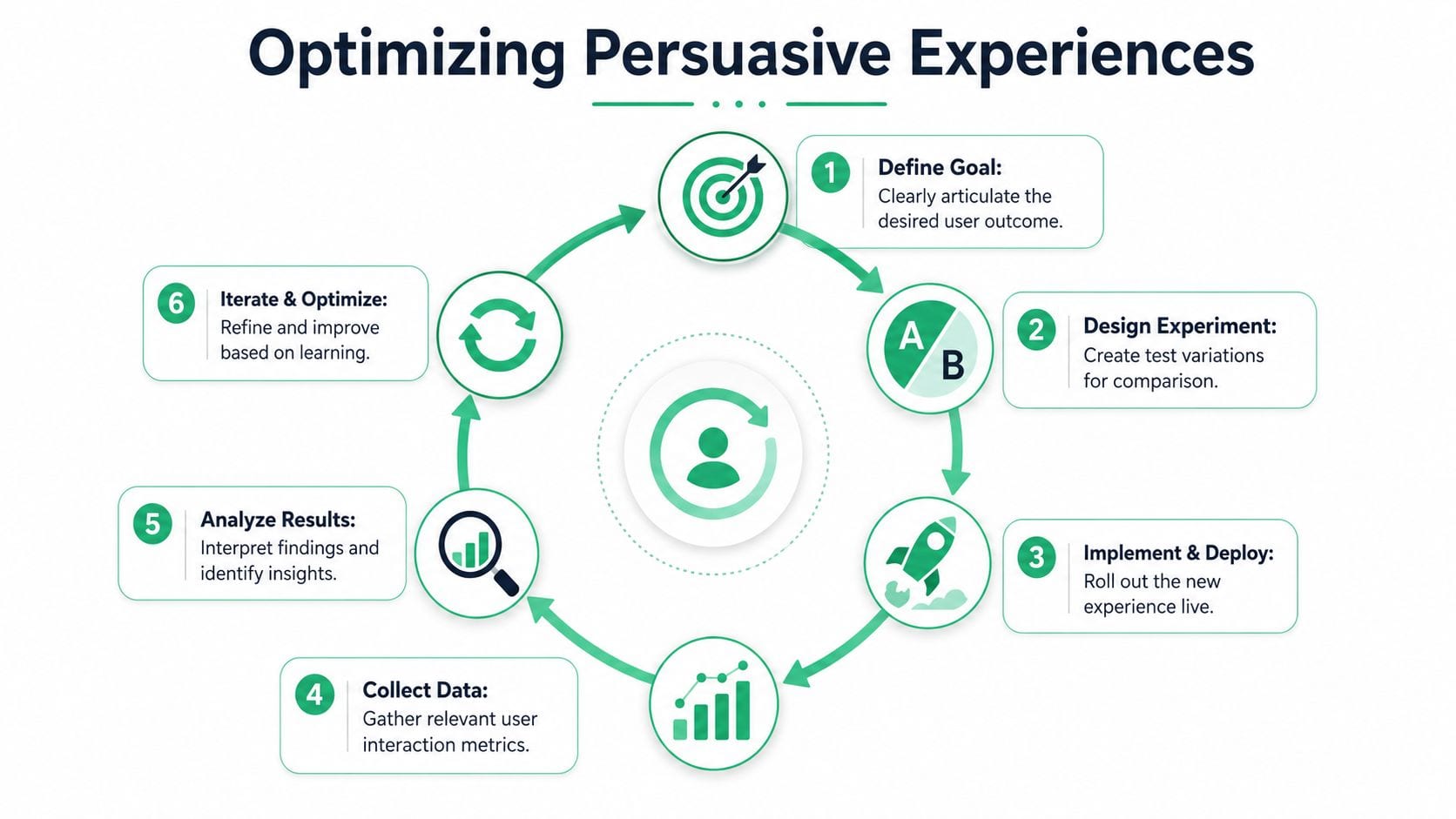
Persuasive design isn't finished when a page goes live. It isn't even finished when an A/B test reaches significance in your dashboard. It is finished only when you can defend the measurement, explain the result, and show that the outcome reflects user behavior rather than tracking drift.
The hidden failure in experimentation
Many teams know how to build a test plan. Fewer teams know how easily measurement errors can invalidate one.
A persuasive variation might appear to win because the success event fired twice. A checkout redesign might look neutral because consent settings suppressed part of the audience. A new landing page might seem weaker because UTM tagging broke halfway through the campaign. In every case, the organization thinks it is learning. In reality, it is accumulating fragile conclusions.
That is why the argument for better analytics QA isn't only operational. It's rhetorical. If your evidence base is unstable, your ability to persuade executives, clients, or cross-functional peers shrinks with it.
What credible measurement looks like
Strong persuasion programs treat measurement design as part of the experience design. Before the test launches, they define:
- The primary outcome that reflects the business goal
- The event logic that records that outcome
- The failure conditions that would make the result untrustworthy
- The ownership model for reviewing anomalies fast
Those teams also avoid a common trap. They don't over-index on whichever metric is easiest to pull. They pick the metric that best represents the user action they want.
For teams expanding their testing discipline, resources that help you learn conversion rate optimization can be useful, especially when they connect experimentation decisions to business outcomes instead of isolated interface tweaks.
Data skepticism is a persuasion problem
The modern version of stakeholder resistance often sounds like this:
- "Can we trust the attribution?"
- "Did the tracking plan change?"
- "Why doesn't this match what sales saw?"
- "Are we sure the event fired on all devices?"
Those are not technical footnotes. They are objections to persuasion.
A 2025 Gartner study found that 59% of CMOs reject proposals when the underlying tracking plans lack automated root-cause analysis, according to this source discussing influence and persuasion. The lesson is uncomfortable but useful. Teams don't lose buy-in only because the story is weak. They lose it because leaders can sense when the measurement chain is incomplete.
When stakeholders detect tracking uncertainty, they downgrade every conclusion that depends on it.
A practical operating model
A persuasive optimization loop should look more like operational discipline than creative inspiration.
| Stage | Team question | Common risk |
|---|---|---|
| Goal definition | What user behavior are we trying to change? | Picking a soft metric |
| Experiment design | What changes behavior in theory? | Testing vague variations |
| Implementation | Did the experience and tracking ship correctly? | Broken tags or event drift |
| Data collection | Are we observing the full journey? | Missing consented traffic or bad UTMs |
| Analysis | Is the result believable? | Treating corrupted data as truth |
| Iteration | What do we change next? | Scaling a false positive |
The teams that get good at this don't separate persuasion, analytics, and QA into different conversations. They make them one conversation.
If your stack includes multiple analytics tools, ad platforms, server-side events, and web plus app flows, this gets harder quickly. That is why many teams look for systems that reduce manual auditing and provide ongoing observability across launches, experiments, and attribution changes. If you're comparing workflows and tooling, this overview of an A/B test platform is useful context for thinking about how testing infrastructure and data quality support each other.
Why observability changes the conversation
When teams can detect missing events, rogue properties, broken pixels, or consent issues quickly, they stop arguing from suspicion. They can show what changed, when it changed, and whether the result should still be trusted.
That changes how persuasion works inside an organization. The analyst is no longer saying, "I think this campaign worked." The analyst is saying, "Here is the outcome, here is how we measured it, and here is why the measurement is reliable."
That is a stronger argument than rhetoric alone can deliver.
If it's possible within your publishing workflow, it also makes sense to embed relevant videos from the Trackingplan YouTube channel near this part of the discussion. Video demos can help teams visualize how analytics QA and observability affect experimentation credibility in real operating environments.
The Ethics of Persuasion and Building Long-Term Trust
The line between persuasion and manipulation is easy to cross when teams are under pressure. A quarterly target gets tight, a funnel underperforms, and suddenly someone wants to hide the cancel button, preselect the expensive plan, or make disclosure text unreadable.
Those tactics can move a number. They also damage trust.
Ethical persuasion is stricter than clever persuasion
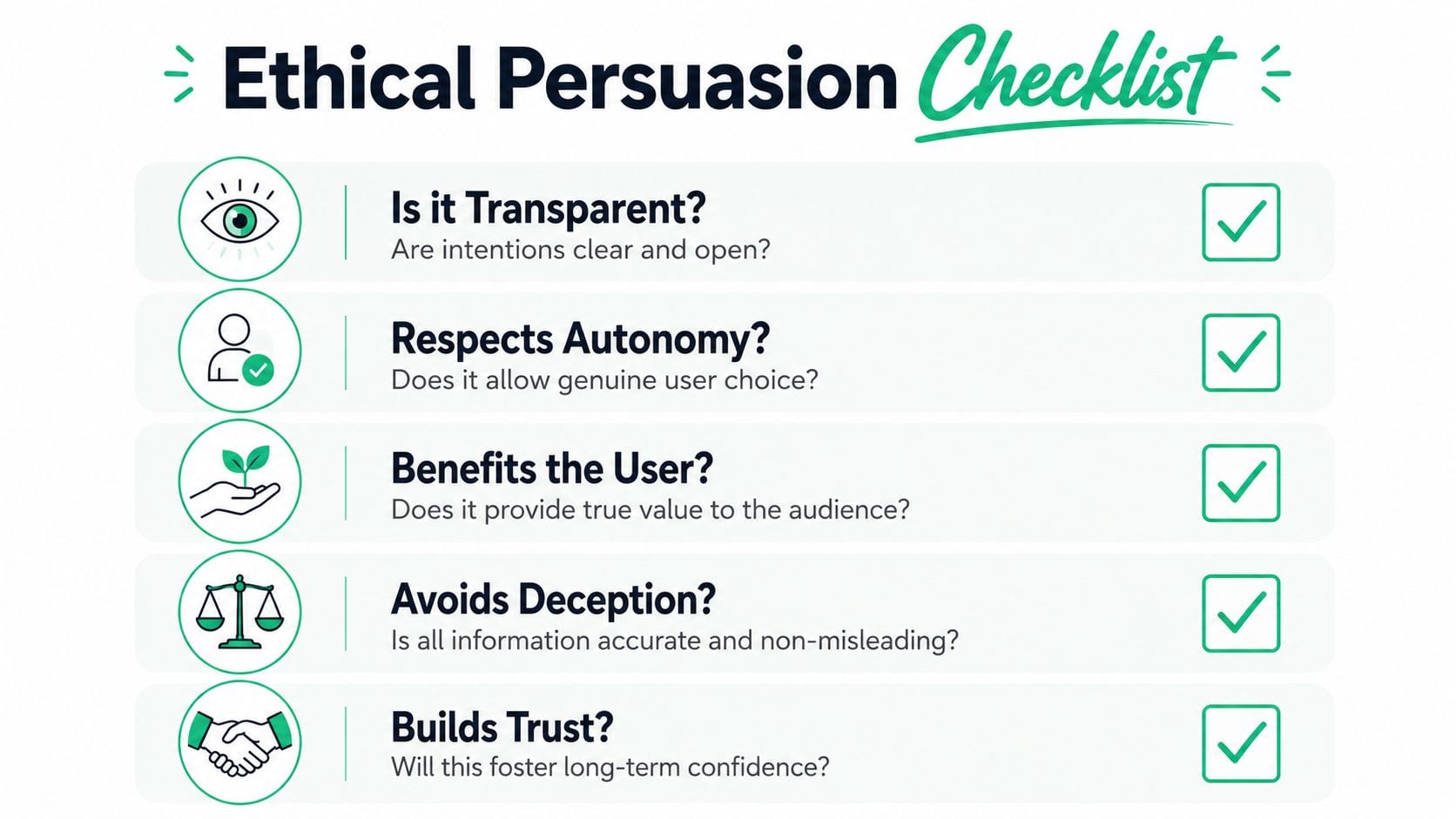
A useful standard is whether the user would still feel fairly treated after understanding exactly how the experience influenced their choice. If the answer is no, the tactic probably belongs in the dark-pattern category.
The CIALDINI-GINO Framework offers a practical way to keep persuasion ethical. It uses three phases focused on authentic authority, identifying resonant social proof through curiosity, and delivering unexpected value aligned with audience interests rather than persuasion goals, as described in this article on the framework. That sequence matters because it forces teams to earn influence instead of extracting it.
A short ethical test for teams
Before shipping a persuasive flow, review it against a few questions:
- Transparency. Can users tell what you're asking and why?
- Choice. Is declining as clear as accepting?
- Value. Does the interaction help the user, not just the business?
- Accuracy. Are claims and proofs represented truthfully?
- Durability. Would you still use this pattern if retention mattered more than immediate conversion?
That last question is where many bad decisions reveal themselves.
A persuasive tactic that creates regret is usually a retention problem in disguise.
Data ethics matter too
Ethical persuasion isn't only about copy and button hierarchy. It also depends on what data you collect, how clearly consent is handled, and whether teams monitor for privacy failures.
If your analytics setup leaks personal data, misstates consent behavior, or captures more than users reasonably expect, then even a polished experience rests on shaky ground. Persuasion built on privacy ambiguity is still manipulation. Teams that want a more durable standard should treat governance as part of UX, not just a legal review step. This is why guidance on privacy and compliance belongs in the same conversation as conversion and experimentation.
Long-term trust comes from consistency. Say what you mean. Measure fairly. Respect the user's agency. That's the version of persuasion that compounds rather than backfires.
Conclusion Persuade with Confidence and Credibility
The best answer to how to persuade isn't "tell a better story." It's "build a story people can trust."
Words still matter. So do offer design, framing, proof, and sequencing. But in digital teams, credibility comes from a combination of behavioral insight and dependable measurement. If the audience doubts the tracking, the recommendation weakens. If the evidence is clean and defensible, even a skeptical room becomes easier to move.
That changes the order of operations.
First, make sure your data collection can support the claim you want to make. Then use persuasion principles to shape the message, the interface, and the ask. After that, test carefully enough that you can separate genuine user response from implementation noise.
The teams that do this well don't rely on charisma. They reduce uncertainty. They make decisions easier. They present evidence that survives scrutiny. And they apply persuasion ethically, so each win strengthens the next one instead of creating distrust.
That is how persuasion becomes repeatable.
Not as a performance skill. As an operating discipline.
If your team needs more confidence in the numbers behind every pitch, experiment, and campaign report, Trackingplan is worth a look. It automatically discovers and monitors analytics, marketing, and attribution data across web, apps, and server-side stacks, helping teams catch broken pixels, missing events, consent issues, UTM errors, and PII risks before those problems undermine trust. For marketers, analysts, developers, and agencies, that means fewer debates about whether the data is wrong and more confidence when it's time to persuade with evidence.