
TL;DR:
- India’s DPDPA is a comprehensive law requiring organizations to get clear consent and provide notice before collecting personal data. It enforces security, breach reporting, and Data Principal rights, with full penalties starting in May 2027. Businesses must treat compliance as an engineering effort, focusing on data inventories, breach workflows, and cross-border rules for effective legal adherence.
India’s Digital Personal Data Protection Act, known as India’s DPDPA, is the country’s first comprehensive law governing how businesses must collect, process, and protect digital personal data. Enacted in 2023 and progressively enforced through phased rules, the DPDPA applies to any organization processing personal data within India and extraterritorially when serving Indian residents. Full enforcement with maximum penalties of up to INR 250 crore takes effect may 13, 2027. That timeline gives businesses a defined window to act, but the compliance work required is substantial, technical, and cross-functional.
What are the core compliance requirements under India’s DPDPA?
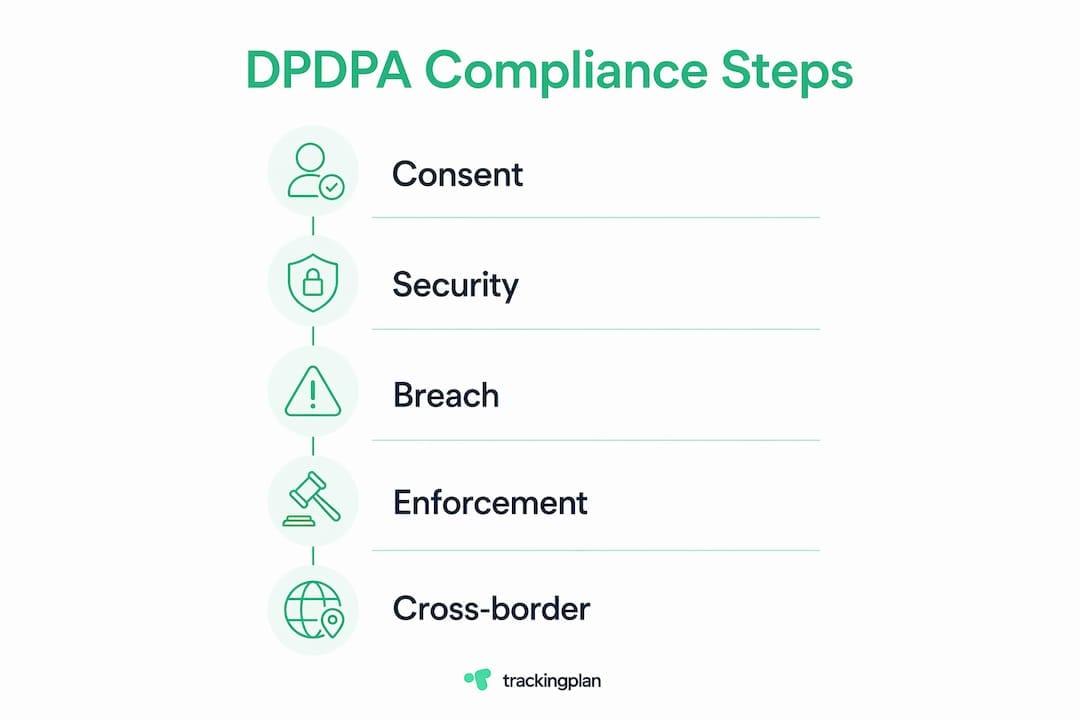
The DPDPA places consent at the center of lawful data processing. Consent must be free, specific, informed, and unambiguous, with a clear mechanism for withdrawal at any time. A single checkbox covering all data uses fails this standard. Each processing purpose requires its own separately managed consent record, including the exact consent text shown to the user and the withdrawal path offered.

Notice obligations run alongside consent. Before collecting data, a business must inform the Data Principal (the individual whose data is collected) of what data is being collected, why it is being collected, and what rights the individual holds. This notice must be clear and in plain language, not buried in a terms-of-service document.
Data Principal rights under the DPDPA include:
- Right to access: Confirmation of what personal data is held and a summary of processing activities
- Right to correction and erasure: The ability to correct inaccurate data or request deletion when the purpose is fulfilled
- Right to grievance redressal: A defined channel to raise complaints, with a response obligation on the business
- Right to nominate: The ability to designate another person to exercise rights in the event of death or incapacity
Security safeguards are mandatory for every Data Fiduciary. Rule 6 specifies seven controls that map directly to ISO 27001 and NIST CSF standards. These controls cover encryption, access management, logging, and incident response. Businesses already aligned with ISO 27001 have a head start, but they still need to verify that their controls satisfy the DPDPA’s specific framing.
Breach notification follows a dual-stage process. The initial notification to the Data Protection Board must go out without delay, with a detailed report within 72 hours. Affected Data Principals must also receive individual notification. This is not a single report filed with a regulator. It is a coordinated workflow touching legal, IT, and communications teams simultaneously.
Pro Tip: Build your breach notification workflow as a documented runbook before you need it. Assign named owners for each step, test it with a tabletop exercise, and integrate it with your SIEM or monitoring platform so detection triggers the process automatically.
How does the phased enforcement model affect compliance planning?
The DPDPA’s phased rollout gives businesses a structured runway, but each phase carries real obligations.
- November 2025: Initial provisions take effect. Businesses must begin aligning consent practices, notice requirements, and grievance mechanisms. Regulators can investigate complaints from this point forward.
- November 2026: Consent Manager registration and compliance requirements activate. Organizations using third-party consent management platforms must verify those platforms meet DPDPA standards.
- May 13, 2027: Full enforcement with maximum penalties of up to INR 250 crore becomes effective. All operational obligations, including security safeguards, breach notification timelines, and Data Principal rights fulfillment, are fully enforceable at this level.
The phased model is not a grace period in the traditional sense. Complaints filed after november 2025 can still result in regulatory action. The escalating penalty structure simply means the financial stakes rise sharply at the may 2027 threshold.
Businesses that wait until early 2027 to begin compliance work will face a compressed timeline for tasks that take months to complete properly. Data flow mapping, consent architecture redesign, and breach detection integration each require dedicated engineering and legal resources. Starting now means you can address each phase deliberately rather than scrambling to meet all obligations at once.
For marketing teams managing automated data collection, reviewing your marketing automation checklist against DPDPA consent requirements is a practical first step before the november 2026 Consent Manager deadline.
What are the rules for Significant Data Fiduciaries and cross-border transfers?
Significant Data Fiduciary designation
The government designates certain organizations as Significant Data Fiduciaries (SDFs) based on the volume of data processed, the sensitivity of that data, the potential risk to Data Principals, and the national security implications of the processing. SDF status triggers additional obligations that go well beyond standard Data Fiduciary requirements.
SDFs must:
- Appoint a Data Protection Officer (DPO) based in India, accountable to the board of directors
- Engage an independent data auditor for periodic compliance assessments
- Conduct Data Protection Impact Assessments (DPIAs) for high-risk processing activities
- Maintain algorithmic accountability measures for automated decision-making systems
The DPO role carries real governance weight. For a detailed breakdown of what that role requires operationally, the DPO responsibilities guide covers the key duties relevant to 2026 compliance programs.
Cross-border data transfers
Cross-border transfers are permitted by default under the DPDPA. The government can issue a negative list of restricted countries, but until that list is published, transfers to any destination are allowed. This is a meaningful difference from the GDPR’s adequacy-decision model, which restricts transfers unless a legal basis for the destination country exists.
Sector-specific localization rules from the Reserve Bank of India (RBI), the Securities and Exchange Board of India (SEBI), and the Insurance Regulatory and Development Authority of India (IRDAI) still apply independently. A fintech company may be free to transfer customer data under the DPDPA while simultaneously being restricted by RBI payment data localization requirements. These two frameworks must be read together, not in isolation.
What are the biggest operational challenges for DPDPA compliance?
DPDPA compliance is a technical and governance program, not a legal audit. The organizations that struggle most are those that treat it as a documentation exercise rather than an engineering one.
The most common operational challenges include:
- Data inventory gaps: Most organizations do not have a complete, current map of where personal data lives, how it flows between systems, and what retention periods apply. Automated scans combined with code-level annotations and data flow tracing are the only reliable way to build and maintain this inventory at scale.
- Consent recordkeeping failures: Storing a boolean “consent given” flag is not sufficient. The DPDPA requires a full audit trail: the exact notice shown, the timestamp, the version of the consent text, and the withdrawal mechanism offered. This demands purpose-built consent infrastructure, not a checkbox in a CRM.
- Breach detection integration: Most compliance failures trace back to poor integration between detection systems and notification workflows. Real-time SIEM coverage is the baseline. Without it, the 72-hour reporting window becomes impossible to meet reliably.
- Data erasure complexity: The DPDPA’s Section 8(7) allows erasure “as far as may be possible,” which acknowledges the technical reality of backups. Naive deletion from primary databases is insufficient. Organizations must document backup retention schedules and build processes to erase data from backup systems when those backups are restored.
- Third-party accountability: Outsourcing data processing to a vendor does not transfer liability. The Data Fiduciary remains responsible. Contracts with Data Processors must specify obligations, and businesses should audit processor compliance rather than assume it.
Pro Tip: Treat your data processing agreements as living documents. Review them whenever a vendor changes its subprocessors, updates its infrastructure, or modifies its data handling practices. A stale DPA is a compliance gap waiting to surface.
For teams managing Data Subject Access Requests, the DSAR fulfillment guide provides a practical framework for meeting the DPDPA’s access and correction rights obligations efficiently.
Key Takeaways
The DPDPA requires businesses to treat data protection as an engineering and governance program, not a one-time legal review.
| Point | Details |
|---|---|
| Phased enforcement timeline | Full penalties up to INR 250 crore apply from may 13, 2027; initial obligations began november 2025. |
| Consent requires an audit trail | Each consent record must capture the notice text, timestamp, purpose, and withdrawal path. |
| Breach notification is dual-stage | Report to the Data Protection Board without delay, then notify affected individuals individually. |
| SDFs face additional obligations | Significant Data Fiduciaries must appoint an India-based DPO, conduct DPIAs, and engage independent auditors. |
| Cross-border transfers are open by default | Transfers are permitted unless the government publishes a restricted-country list; sector rules still apply separately. |
The compliance gap most businesses are not talking about
The conversation around the DPDPA tends to focus on consent banners and privacy policies. Those matter, but they are the visible surface of a much deeper engineering problem. What I have seen consistently is that organizations underestimate how long it takes to build a reliable data inventory. You cannot manage what you cannot see, and most businesses have personal data scattered across CRMs, analytics platforms, data warehouses, third-party APIs, and legacy systems that nobody has fully documented in years.
The breach notification requirement is where this gap becomes dangerous. A 72-hour window sounds manageable until you realize that the clock starts at detection, not at confirmation. If your detection systems are not integrated with your notification workflows, you will spend the first 48 hours just figuring out what happened and who is affected. That leaves almost no time to draft, approve, and send legally compliant notifications to the Data Protection Board and to every affected individual.
My honest view is that the businesses that will handle DPDPA enforcement well are the ones treating compliance as a continuous monitoring program rather than a project with a finish line. The regulation will evolve. The government’s negative list for cross-border transfers will eventually be published. SDF designations will expand. Enforcement patterns will emerge from early Data Protection Board decisions. The organizations with live data inventories, real-time monitoring, and tested breach response workflows will adapt quickly. Everyone else will be reacting.
— David
How Trackingplan supports your DPDPA compliance program
Accurate data mapping and real-time monitoring are the foundation of any credible DPDPA compliance program. Trackingplan’s automated discovery and auditing platform gives organizations a continuous view of their digital data flows, tracking implementations, and schema changes across websites, apps, and server-side environments.

Trackingplan detects consent enforcement errors, schema mismatches, and tracking anomalies the moment they occur, sending alerts via Slack, email, or Teams. That real-time visibility directly supports the breach detection and notification readiness the DPDPA demands. For teams managing digital analytics data quality, Trackingplan provides the audit trail and monitoring infrastructure that compliance programs require without adding manual overhead.
FAQ
What is India’s DPDPA?
India’s DPDPA, formally the Digital Personal Data Protection Act 2023, is India’s first comprehensive law governing digital personal data. It applies to all organizations processing personal data within India and to those offering goods or services to Indian residents from abroad.
When does full DPDPA enforcement begin?
Full enforcement with maximum penalties of up to INR 250 crore takes effect on may 13, 2027. Initial provisions and complaint mechanisms have been active since november 2025.
How does DPDPA differ from GDPR?
The DPDPA permits cross-border data transfers by default, unlike the GDPR’s adequacy-decision model. The DPDPA also does not require a legal basis beyond consent for most processing, whereas the GDPR recognizes six lawful bases.
Who qualifies as a Significant Data Fiduciary?
The government designates SDFs based on data volume, sensitivity, risk to Data Principals, and national security considerations. SDFs must appoint an India-based DPO, conduct DPIAs, and engage an independent data auditor.
What does DPDPA require for breach notification?
Businesses must notify the Data Protection Board without delay and submit a detailed report within 72 hours of detecting a breach. Each affected Data Principal must also receive individual notification.