
TL;DR:
- Paid search optimization in 2026 relies on accurate conversion data and structured campaign setup. Regular weekly reviews of search terms, tracking, and bid adjustments improve campaign performance. AI automation handles bidding, but human judgment remains crucial for defining high-value conversions and maintaining quality signals.
Paid search optimization is the process of refining bids, keywords, ad structure, and conversion tracking to maximize ROI and improve ad placement across search platforms. The discipline has shifted significantly in 2026. AI-driven automation now handles tactical bid adjustments, but the quality of data signals feeding those algorithms determines whether campaigns succeed or waste budget. Marketers who treat paid search as a set-and-forget system consistently underperform those who build disciplined review cycles around accurate tracking data.
How to structure campaigns for paid search optimization
Campaign structure is the foundation every bidding algorithm builds on. Fragmented single-keyword ad groups made sense when marketers controlled every match type manually. Today, that approach starves machine learning of the data volume it needs to function well.
Theme-based, consolidated ad groups give algorithms more conversion signals per group. Algorithms require 2–4 weeks of consistent data in a consolidated structure to stabilize and optimize effectively. Splitting traffic across dozens of micro-groups resets that learning window repeatedly and keeps performance volatile.
Effective segmentation follows two principles: intent and margin. Separate campaigns by funnel stage, not just product category. A campaign targeting “buy running shoes” should never share a budget with one targeting “best running shoes for beginners.” The purchase intent differs, and so should the bid strategy and landing page.
Brand and non-brand campaigns require hard separation. Non-brand campaigns compete in an open auction and carry higher CPCs. Brand campaigns typically convert at lower cost and higher rate. Mixing them obscures true performance and makes budget decisions harder to defend.
- Consolidate ad groups around 3–5 closely related themes rather than individual keywords
- Separate brand and non-brand campaigns with distinct budgets and bid strategies
- Segment by intent level: informational, comparative, and transactional
- Segment by product margin when revenue value differs significantly across SKUs
- Assign conversion goals at the campaign level to feed the algorithm relevant signals
Pro Tip: Establish a conversion hierarchy before launching any campaign. Define your primary conversion (purchase, lead form) and secondary conversions (page view, add to cart) separately. Feeding mixed-value signals to the algorithm without weighting them causes it to chase low-value actions at the expense of real revenue.
What is search term hygiene and why does it matter?
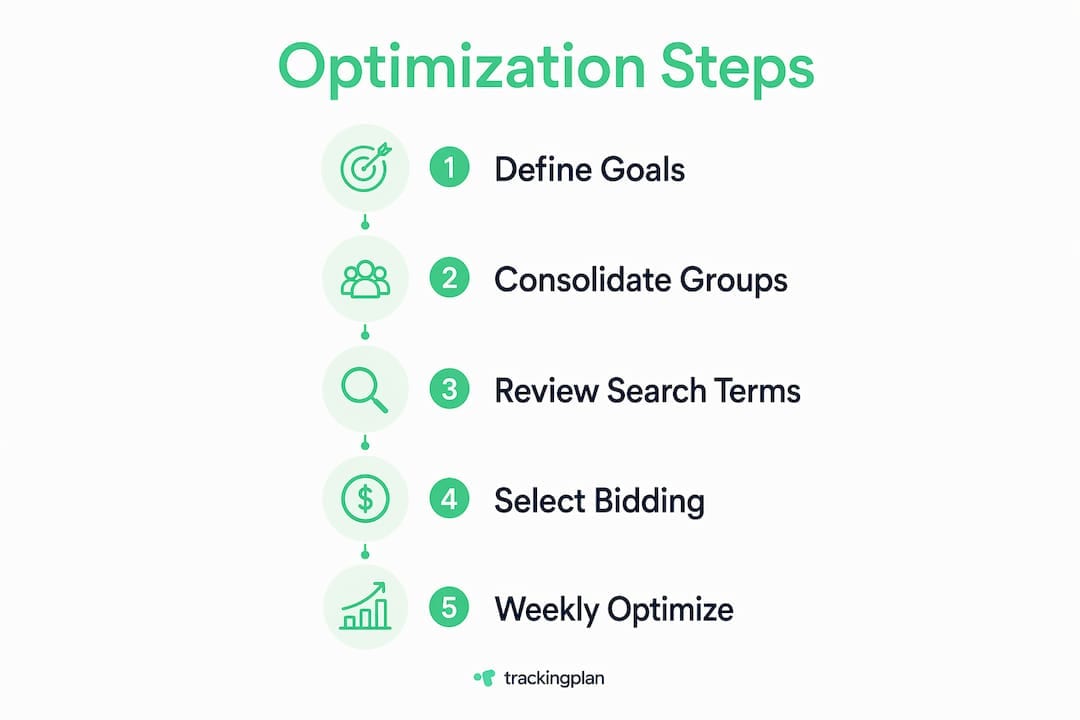
Search term hygiene is the practice of reviewing actual search queries that triggered your ads, then excluding irrelevant ones through negative keywords. It is the highest-leverage routine activity in PPC management strategies because it directly protects budget from waste.
The numbers are concrete. One dataset of 74 accounts showed that excluding approximately 6.9% of the unique query surface saved around $20,713 in wasted spend. That figure represents budget recovered without touching bids or creative. It goes straight back to funding clicks that actually convert.
Approximately 32,201 negative keyword exclusions prevented over $20,712 in wasted spend across accounts in Q1 2026 alone. That scale of exclusion is not achievable through manual review alone. Automation flags irregular queries, but human judgment decides which ones to exclude. Removing a query that looks irrelevant but actually drives assisted conversions is a real risk without that oversight.
Build your negative keyword lists by category:
- Irrelevant industries. If you sell B2B software, exclude queries containing “free,” “open source,” “tutorial,” and competitor brand names.
- Low-value intent terms. Exclude “DIY,” “how to make,” “free template,” and similar phrases that signal users who will not buy.
- Jobs and education queries. Exclude “careers,” “salary,” “course,” “certification,” and “degree” unless you are actively recruiting or selling training.
- Competitor brand names. Exclude these unless you have a deliberate conquest campaign with separate budget and messaging.
- Navigational queries for other brands. Users searching for a specific competitor by name are not your audience at that moment.
Pro Tip: Schedule a weekly 30-minute search term review as a non-negotiable calendar block. Review the prior seven days of queries, flag new irrelevant patterns, and add them to the appropriate shared negative list. Consistency here compounds over time.
How do bidding strategies affect campaign profitability?
Bidding strategy selection is where most accounts leave the most money on the table. The choice between volume-based and value-based bidding is not a preference. It is a structural decision with measurable revenue consequences.
Volume-based strategies like Maximize Conversions tell the algorithm to get as many conversion events as possible within budget. Value-based strategies like Maximize Conversion Value tell it to prioritize revenue. Data shows a 6.44x versus 1.96x ROAS gap between value-based and volume-based bidding. That gap is not marginal. It reflects a fundamentally different optimization target.
The prerequisite for switching to value-based bidding is accurate revenue tracking. Corrupted or incomplete conversion data misleads AI bidding algorithms toward inefficient spending. If your tracking fires on page loads instead of confirmed purchases, the algorithm optimizes for the wrong event. Fix the tracking before changing the strategy.
The recommended sequencing for new campaigns follows a clear path:
- Phase 1. Launch with Maximize Conversions to accumulate data and stabilize the algorithm within the 2–4 week learning window.
- Phase 2. Once you have consistent weekly conversion volume, introduce a target CPA (tCPA) constraint to control cost efficiency.
- Phase 3. When revenue tracking is verified and stable, shift to Maximize Conversion Value or target ROAS (tROAS) to prioritize profitability over volume.
- Phase 4. Feed offline conversion data, such as closed deals or qualified leads, back into the platform to sharpen algorithm accuracy.
Bidding algorithms maximize budget spend unless guardrail conversion signals are defined precisely to reflect real revenue or high-value leads. Without those guardrails, the algorithm will find conversions. They just may not be the ones that grow your business.
Why does a weekly optimization cadence outperform ad hoc management?
Paid search management works best as a repeatable operating system, not a reactive task. Under 10% of accounts conduct weekly updates. The accounts that do maintain that cadence hold a consistent performance advantage over those that do not.
A weekly review cycle covers five core tasks:
- Search term audit. Review new queries, update negative lists, and flag any new irrelevant patterns.
- Tracking integrity check. Verify that conversion tags fire correctly and that no tracking gaps appeared due to site changes or tag manager errors.
- Spend pacing review. Confirm that budgets are distributing as planned and that no campaign is throttling or overspending.
- Bid adjustment review. Assess device, location, and audience bid modifiers based on the prior week’s performance data.
- Quality score monitoring. Check for landing page relevance drops or ad relevance issues that signal misalignment between ads and queries.
Consistency in weekly optimization creates stability that accounts lacking strong cadence cannot replicate. The PPC audit checklist approach formalizes this into a repeatable process that prevents oversight gaps from compounding into larger problems.
Pro Tip: Use automation rules to flag anomalies, such as a sudden CPC spike or a conversion rate drop below a defined threshold. Let automation surface the alert, then apply human judgment to diagnose the cause before making any bid or budget change.
How do landing pages and ad creative affect paid search performance?
Landing pages are no longer passive destinations. AI evaluates landing page content contextually to align ads with searcher intent without requiring a bid on every keyword variant. A well-written, intent-matched landing page extends your targeting reach without increasing keyword complexity.
Search platforms rely on a complex web of signals beyond keywords, including audience data, landing page context, and historical conversions. This means your landing page content directly influences which auctions you appear in and at what cost. A landing page that clearly communicates a specific value proposition for a specific audience segment lowers your cost per click by improving Quality Score.
Responsive Search Ads (RSAs) follow the same logic. Up to 15 headlines and 4 descriptions improve system learning when they communicate genuinely distinct value propositions. Writing 15 variations of the same headline wastes the asset set. Each headline should address a different angle: price, speed, trust, feature, or audience segment.
Apply these principles to your creative assets:
- Write headlines that cover distinct angles: one for price, one for a key feature, one for a customer outcome, one for urgency
- Match the landing page headline to the ad group’s primary theme, not just the keyword
- Align descriptions with the intent bucket: transactional pages need proof and a clear call to action, informational pages need context and a next step
- Rotate creative assets regularly and pause underperformers based on asset-level performance data, not campaign-level averages
A modern paid media strategy treats creative and landing pages as part of the same signal system. Optimizing one without the other produces diminishing returns.
Key Takeaways
Paid search optimization in 2026 requires accurate conversion data, consolidated campaign structures, and disciplined weekly review cycles to give AI bidding algorithms the signals they need to perform.
| Point | Details |
|---|---|
| Consolidate campaign structure | Theme-based ad groups give algorithms 2–4 weeks of clean data to stabilize and optimize effectively. |
| Prioritize search term hygiene | Weekly negative keyword reviews can prevent thousands of dollars in wasted spend per quarter. |
| Sequence bidding strategies | Start with Maximize Conversions, then shift to value-based bidding once revenue tracking is verified. |
| Maintain a weekly cadence | Fewer than 10% of accounts review weekly; those that do hold a measurable performance advantage. |
| Treat landing pages as signals | AI reads landing page content to infer intent, so page relevance directly affects auction eligibility and CPC. |
The signal architect: why I changed how I think about PPC
The biggest shift I have seen in paid search over the past few years is not a new feature or a platform update. It is a change in what the job actually is. Marketers who still spend most of their time adjusting individual keyword bids are optimizing the wrong layer. The algorithm handles that now, and it does it faster and at a scale no human can match.
What the algorithm cannot do is decide what a high-value conversion looks like for your business. It cannot verify that your tracking fires correctly after a site redesign. It cannot recognize that a query category is pulling in job seekers instead of buyers. Those decisions require human judgment, domain knowledge, and a disciplined review process.
The shift from manual PPC management to automation oversight is not a loss of control. It is a redistribution of where your attention creates the most value. The marketers who adapt to that shift and build clean data inputs, clear conversion hierarchies, and consistent weekly routines are the ones whose accounts compound in performance over time. The ones who resist it spend their time on tasks the algorithm already handles better.
— David
Accurate tracking is the backbone of every paid search gain
Every bidding strategy, every negative keyword list, and every creative test depends on one thing: clean, accurate conversion data. If your tracking fires on the wrong event or misses conversions entirely, the algorithm optimizes toward a fiction.


Trackingplan monitors your digital analytics implementation in real time, catching broken pixels, missing conversion tags, and schema mismatches before they corrupt your bidding data. The platform sends instant alerts via Slack, email, or Teams when anomalies appear, so your team can act before wasted spend accumulates. For teams running paid search at scale, web tracking monitoring is the layer that keeps every other optimization decision grounded in reality.
FAQ
What is paid search optimization?
Paid search optimization is the ongoing process of refining bids, keywords, ad structure, and conversion tracking to improve ROI and ad placement in search engine auctions.
How often should I review my paid search campaigns?
Weekly reviews deliver the strongest performance advantage. Fewer than 10% of accounts update weekly, and those that do consistently outperform accounts managed on an ad hoc basis.
What is the best bidding strategy for Google Ads in 2026?
Value-based strategies like Maximize Conversion Value outperform volume-based strategies significantly, but they require verified revenue tracking before switching. Start with Maximize Conversions to build data, then transition.
How do negative keywords reduce wasted ad spend?
Negative keywords exclude irrelevant search queries from triggering your ads. One analysis of 74 accounts found that excluding roughly 6.9% of unique queries saved over $20,000 in wasted spend.
Why does landing page quality affect paid search costs?
AI platforms scan landing page content to infer searcher intent and determine ad relevance. A landing page that clearly matches the ad group’s theme improves Quality Score, which lowers your cost per click and improves ad placement.