
TL;DR:
- Most websites fail to meet cookie compliance standards, risking hefty fines and legal action.
- Technical issues like cookies firing before consent are the main compliance failures.
- Ongoing automated and manual audits are essential for maintaining long-term cookie compliance.
Most websites are one audit away from a painful surprise. Only 15% of EU sites meet minimum cookie compliance standards, and US rates are even lower, while regulators are actively handing out fines that run into the millions. For digital marketing professionals and compliance officers, assuming your site is covered is no longer good enough. This guide walks you through exactly how to check, test, and fix cookie compliance issues before regulators or angry users find them first. From understanding the legal landscape to running technical audits and setting up ongoing monitoring, every step is here.
Table of Contents
- Understanding cookie compliance: Laws, risks, and recent enforcement
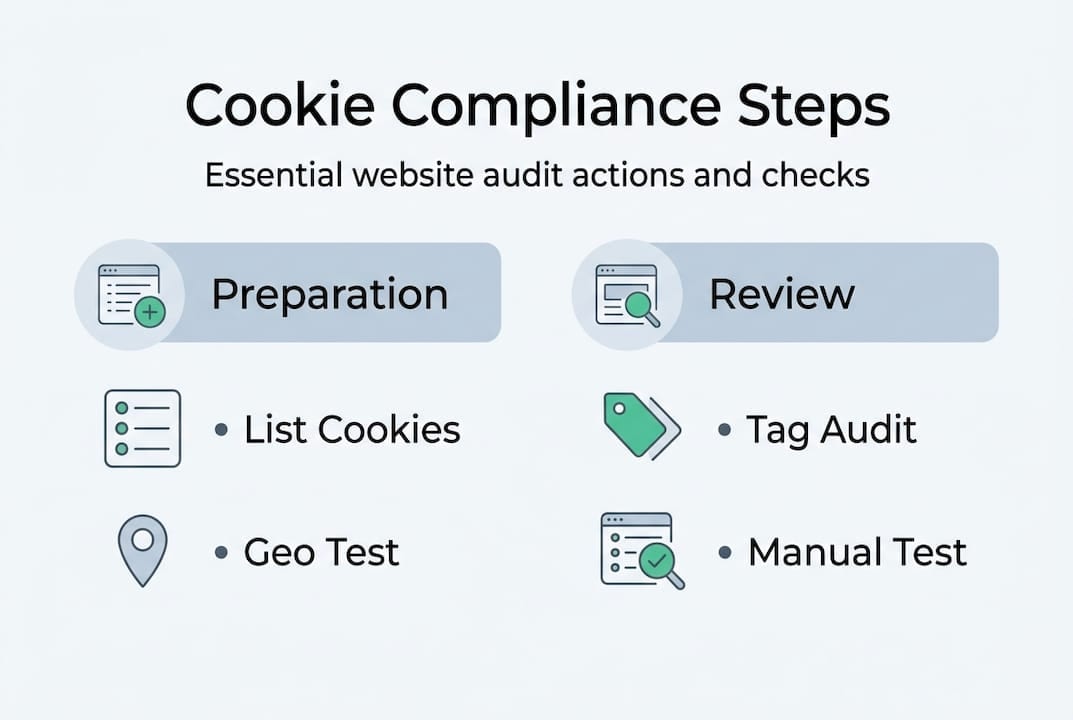
- Prepare: What you need before checking cookie compliance
- How to check your website’s cookie compliance: A step-by-step walkthrough
- Common cookie compliance pitfalls and how to avoid them
- Ongoing monitoring and periodic audits: Sustaining compliance long-term
- Our perspective: Focusing less on banners, more on real technical audits
- Take your cookie compliance to the next level
- Frequently asked questions
Key Takeaways
| Point | Details |
|---|---|
| Enforcement is accelerating | Global regulators are increasing fines, with technical non-compliance now the main focus. |
| Audits are essential | Automated tools plus manual tests catch most compliance gaps and should be run routinely. |
| Reject flow needs scrutiny | Many sites still drop cookies even if a user clicks ‘reject,’ posing a risk even with CMP tools. |
| Documentation streamlines fixes | Keeping thorough audit records and checklists helps quickly resolve issues flagged by compliance tests. |
Understanding cookie compliance: Laws, risks, and recent enforcement
Cookie compliance means more than slapping a banner on your homepage. At its core, it requires obtaining prior, informed consent from users before setting any non-essential cookies, offering a genuine and equally easy reject option, avoiding dark patterns that nudge users toward acceptance, and honoring opt-out requests fully. That last point trips up more organizations than you might expect.
Three legal frameworks dominate the conversation right now:
- GDPR (EU and UK): Requires explicit, freely given consent before non-essential cookies fire. No pre-ticked boxes, no buried reject options.
- ePrivacy Directive: Specifically governs cookies and electronic communications across the EU, operating alongside GDPR.
- CCPA (California): Focuses on opt-out rights rather than prior consent, but still demands clear disclosure and a real mechanism to say no.
The enforcement picture has sharpened considerably. CNIL fined American Express €1.5M and Google €325M in 2025 alone for cookie rule violations. These are not small players making rookie mistakes. They are organizations with dedicated compliance teams who still got caught by technical misconfigurations.
“The biggest compliance failures are not legal misunderstandings. They are engineering problems: cookies firing before consent, reject buttons that don’t actually stop tracking, and third-party scripts running unchecked.”
The gap between jurisdictions is striking. UK sites hit 95%+ compliance among top 1,000 sites after the ICO’s proactive enforcement push, while EU averages sit near 15% and US rates trail further behind. US retailers have faced fines specifically for cookie consent misconfigurations and excessive opt-out hurdles.
Using consent and cookies checking tools alongside a review of cookie audit tools gives you a starting point, but understanding the legal stakes is what motivates the rigor you actually need.
Prepare: What you need before checking cookie compliance
A cookie compliance check without the right team and tools is like a financial audit without access to the books. Before you run a single scan, get organized.
Who needs to be in the room:
- IT or engineering (for tag manager access and server-side config)
- Marketing (to understand what tags and pixels are deployed)
- Legal or compliance (to interpret findings against applicable law)
Tools to have ready:
| Tool type | Purpose | Examples |
|---|---|---|
| Cookie scanner | Detect all cookies set on each page | OneTrust, Cookiebot, CookieYes |
| Tag manager access | Review which tags fire and when | Google Tag Manager, Tealium |
| Browser DevTools | Manual inspection of cookie drops | Chrome DevTools, Firefox |
| CMP dashboard | Verify consent configuration | OneTrust, Usercentrics |
| Audit documentation | Record findings and remediation | Spreadsheet or compliance platform |
What to gather before starting:
- Your current CMP settings and consent categories
- Your published privacy policy (check it matches actual cookie behavior)
- A list of all active third-party scripts and pixels
- Historical audit reports if they exist
- Google Consent Mode v2 configuration (mandatory for ad measurement in 2026)
One counterintuitive finding worth knowing: sites using CMPs have 6.9x more cookies on average, and 15% of CMP users still violate rules. Having a consent platform does not mean you are compliant. It means you have more to audit.
Pro Tip: Schedule geo-targeted banner tests as part of your prep. A user in California should see a CCPA-aligned banner, while a user in Germany needs a GDPR-compliant flow. Testing both from the start saves rework later. Your website auditing checklist and a solid cookie scanner tool will anchor the whole process.
How to check your website’s cookie compliance: A step-by-step walkthrough
With your checklist and tools ready, here is how to systematically check and validate cookie compliance on your website.
- Run an automated cookie scan. Use a reputable scanner to crawl your site and generate a list of every cookie set, its category, duration, and whether it fires before or after consent.
- Map cookies to consent categories. Cross-reference your CMP’s configured categories (analytics, marketing, functional) against what the scanner found. Mismatches are red flags.
- Test the accept flow. Accept all cookies and confirm the expected cookies are set. Nothing unusual should appear that was not listed in your CMP.
- Test the reject flow. This is where most sites fail. Reject all cookies and verify that only strictly necessary cookies remain. 50% of sites still leak cookies after a user clicks reject.
- Check for pre-consent drops. Load your site in a clean browser session with no prior consent. Open DevTools and inspect cookies before interacting with any banner. Any non-essential cookie set at this point is a violation.
- Verify opt-out parity. Rejecting consent must be as easy as accepting it. Count the clicks required for each path. If rejecting takes three extra steps, that is a dark pattern.
- Test geo-targeted flows. Use a VPN or browser extension to simulate EU and US user sessions. Confirm each jurisdiction sees the correct banner and consent mechanism.
Manual vs. automated testing comparison:
| Method | Strengths | Limitations |
|---|---|---|
| Automated scanning | Fast, scalable, repeatable | Misses runtime and dynamic behavior |
| Manual testing | Catches edge cases, consent flow logic | Time-intensive, hard to scale |
| Combined approach | Most thorough | Requires planning and resources |
Pro Tip: Use automated cookie audit tools for breadth and manual testing for depth. Understanding Google Consent Mode v2 is essential in 2026, as ad platforms now require it for measurement. Brush up on consent management fundamentals if your team is newer to this space.
Common cookie compliance pitfalls and how to avoid them
Even a rigorous check sometimes misses technical or process gaps. Here is where organizations consistently get it wrong.
The most common pitfalls:
- CMP misconfiguration: Categories are set up incorrectly, so marketing cookies fire under a functional label.
- Default opt-in: Consent checkboxes pre-ticked, or banners that assume consent on scroll or continued browsing.
- Missing reject option: The reject button is absent, hidden, or requires navigating through multiple screens.
- No withdrawal mechanism: Users can consent but cannot easily revoke it later.
- Third-party script leaks: Embedded widgets, chat tools, or social share buttons drop cookies independently of your CMP.
- Geo-targeting failures: The same banner serves all users regardless of location, violating jurisdiction-specific rules.
15% of CMP-equipped sites still set unauthorized cookies, and Google Tag Manager specifically needs consent mode configured correctly to prevent non-essential tags from firing without permission.
“Runtime cookie leaks are the compliance gap nobody talks about enough. A site can look perfectly compliant in a static audit and still be dropping analytics cookies on every reject click because of a poorly sequenced tag trigger.”
The fix for most of these issues is not a new privacy policy. It is a technical review of your tag firing logic, your CMP category mappings, and your consent signal propagation. Learn more about eliminating tracking cookies and building a privacy-first marketing approach that does not rely on workarounds.

Ongoing monitoring and periodic audits: Sustaining compliance long-term
Addressing common pitfalls is just the start. Sustained compliance means putting robust audit routines in place for the future, because your site changes constantly and so do the regulations.
A practical audit cycle:
- Quarterly formal audits. Run a full cookie scan, review CMP configurations, and test all consent flows. Document findings and remediation actions.
- Post-deployment checks. Any time a new tag, pixel, or third-party integration goes live, run a targeted compliance check before it reaches production.
- Annual legal review. Have your legal team review applicable regulations for updates and assess whether your consent language still meets current standards.
- Continuous monitoring. Set up real-time alerts for unexpected cookie drops or consent signal failures between formal audits.
- Regression testing. After any CMP update or site redesign, re-run the full compliance test suite to catch regressions.
The UK ICO’s model is instructive here. Proactive testing and enforcement drove compliance among major UK sites from scattered results to 95%+. The lesson is that ongoing monitoring, not one-time fixes, is what separates compliant organizations from those that drift back into violation.
Compliance KPIs worth tracking include: percentage of pages with pre-consent cookie drops (target: zero), reject flow click parity vs. accept flow, number of unauthorized cookies detected per audit cycle, and time to remediation after a finding. Bookmark the best cookie audit tools that fit your stack and build them into your regular workflow.
Our perspective: Focusing less on banners, more on real technical audits
Here is the uncomfortable truth about where most organizations still get cookie compliance wrong: they treat it as a design and legal problem when it is fundamentally an engineering problem.
Updating banner copy or rewriting your privacy policy feels like progress. It rarely is. Regulators are now targeting technical failures specifically: cookies dropping before consent fires, reject signals that get ignored by downstream tags, and third-party scripts that operate outside the CMP’s control entirely.
We have seen organizations spend significant resources on beautiful, legally worded consent banners while their tag manager quietly fires analytics and advertising pixels on every page load regardless of user choice. The banner is compliant. The site is not.
The organizations that stay ahead of enforcement are the ones running automated cookie audits continuously, not just before a regulatory review. They test edge cases: what happens on a slow connection when the CMP loads after a third-party script? What happens on a mobile device with a cached consent state? These are the scenarios that generate real violations and real fines.
Automated tools plus disciplined manual review is the combination that actually works.
Take your cookie compliance to the next level
Everything covered in this guide requires consistent execution, and that gets hard to sustain manually as your site grows. Trackingplan’s web tracking monitoring platform automates much of the discovery and alerting work, flagging unexpected cookie behavior, consent signal failures, and tracking anomalies in real time before they become regulatory problems.
Trackingplan integrates directly with your existing digital analytics tools so your compliance monitoring sits alongside your performance data, not in a separate silo. Whether you are running quarterly audits or need continuous oversight across multiple client sites, Trackingplan gives your team the visibility to act fast and stay ahead of enforcement.
Frequently asked questions
How can I quickly check if my website is cookie compliant?
Run a scan using a reputable cookie audit tool, then manually test your accept and reject flows to confirm that only 15% of EU sites currently meet minimum standards. No cookies should fire before consent or after a rejection.
What are the most common website cookie compliance mistakes?
Failing to provide a genuine reject option, dropping cookies before consent is given, and misconfigured CMPs are the leading causes of violations. CNIL fined major companies specifically for pre-consent cookies and poor opt-out experiences.
Do automated cookie compliance tools guarantee legal compliance?
No. Automated tools are essential for scale but must be paired with manual testing to catch runtime and cross-site consent issues. 50% of sites leak cookies despite using compliance tools, because dynamic behavior requires human verification.
How often should I audit my website for cookie compliance?
Audit formally at least quarterly and after any major site update or regulatory change. The UK ICO’s ongoing monitoring model shows that continuous oversight, not periodic snapshots, is what drives lasting compliance.
Are US rules for cookie compliance different than EU rules?
Yes. The EU requires prior consent and an easy reject option under GDPR, while the US under CCPA focuses on opt-out rights after the fact. EU requires more robust consent flows, and US sites currently show higher violation rates partly because the legal bar has been set lower.