
TL;DR:
- One-third of companies incurred compliance-related penalties in the past year, averaging $16,000 per organization. Continuous, real-time monitoring of user consent, tag deployment, and data flows significantly reduces risk and operational costs in digital marketing. Implementing automated compliance tools like Trackingplan enhances data integrity, audit readiness, and regulatory relationships, transforming compliance into a strategic advantage.
One-third of companies incurred compliance-related penalties in the past year, averaging $16,000 per company. For marketing teams running dozens of pixels, consent flows, and attribution integrations simultaneously, that number should be a wake-up call. The importance of tracking compliance is rarely understood until a regulator calls, an audit fails, or a campaign fires data into the void without valid user consent. This guide breaks down what compliance tracking actually requires in digital marketing, why continuous monitoring is the only approach that works, and which techniques separate organizations that manage risk well from those that stumble into expensive violations.
Table of Contents
- Understanding compliance tracking in digital marketing
- How real-time compliance monitoring reduces risk and cost
- Privacy-compliant tracking techniques for digital marketing campaigns
- Common challenges and advanced solutions in compliance tracking
- Strategic benefits of compliance tracking for performance and reputation
- Why many organizations still struggle with compliance tracking — and how to fix it
- Boost your compliance tracking with Trackingplan’s real-time monitoring solutions
- Frequently asked questions
Key Takeaways
| Point | Details |
|---|---|
| Compliance penalizes lapses | A third of companies face costly fines each year due to missed compliance tracking, highlighting financial risks. |
| Real-time monitoring saves resources | Continuous, automated compliance tracking reduces expenses and manual workload by up to 40%. |
| Privacy compliance is essential | Using technology like Google Consent Mode v2 and CMPs ensures lawful data use while preserving marketing insights. |
| Centralized tracking prevents blind spots | Consolidated systems with clear ownership and alert escalation avoid data silos and overlooked risks. |
| Compliance strengthens strategy | Proactive tracking enables regulatory goodwill, operational resilience, and improved stakeholder trust. |
Understanding compliance tracking in digital marketing
To grasp why tracking is vital, we first need to clarify what compliance tracking involves in digital marketing operations.
Most marketing teams think of compliance as a legal department concern. They handle privacy policies, check a few boxes before a product launch, and move on. That is the mindset that leads to $16,000 penalties. Compliance tracking is an ongoing process, not a one-time task, and in digital marketing it spans far more ground than a legal review ever will.
Compliance tracking includes monitoring licenses, certifications, permits, and regulatory obligations relevant to your industry. In marketing, that translates to managing user consent signals, verifying tag behavior, auditing data collection practices, and confirming regulatory filings stay current. Any one of those can go wrong silently, with no visible error message and no warning until an audit surfaces the gap.
The components marketing teams must actively track include:
- User consent status across sessions, devices, and geographies
- Tag and pixel deployment to confirm they fire only when and how they should
- Data schema integrity so collected events match what analytics tools expect
- Regulatory filing deadlines for certifications, data processing agreements, and retention limits
- Attribution data flows from ad platforms back to your analytics stack
Clear ownership is what makes this work. When no single person or team is accountable for a specific compliance obligation, it gets missed. A good consent management guide will tell you the same thing: technology handles the mechanics, but humans have to own the outcomes.
How real-time compliance monitoring reduces risk and cost
Building on its definition, let’s explore how transforming compliance into a real-time, automated process drastically reduces risk and cost.
Traditional compliance audits happen quarterly or annually. By the time an auditor flags a broken consent flow or a rogue pixel, that tag may have been firing without proper consent for months. Real-time compliance monitoring closes that gap by shifting the work from reactive cleanup to continuous detection.

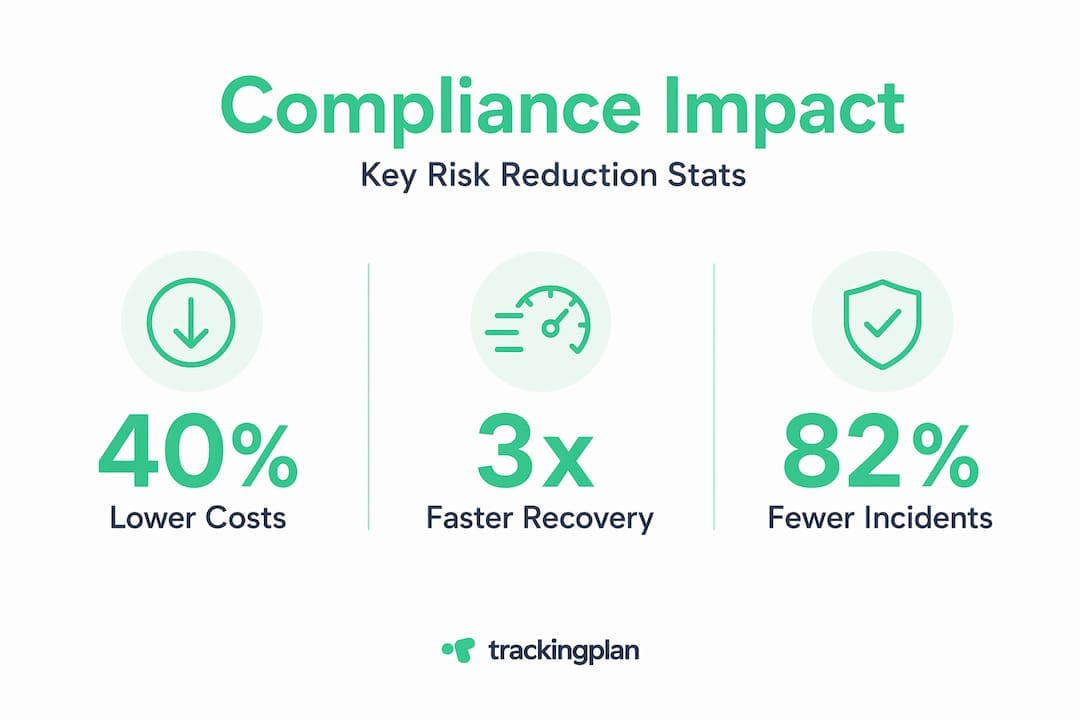
Organizations using automated GRC tools for real-time compliance tracking report up to a 40% reduction in compliance-related expenses. That figure becomes intuitive once you consider what periodic audits actually cost: consultant fees, emergency developer time, legal reviews, and the operational disruption of fixing what should have been caught weeks earlier.
Here is how real-time monitoring compares to manual periodic auditing:
| Dimension | Manual periodic auditing | Real-time automated monitoring |
|---|---|---|
| Detection speed | Weeks to months | Minutes to hours |
| Error scope | Issues found at audit point only | Continuous across all events |
| Cost of remediation | High, due to accumulated failures | Low, caught at point of origin |
| Audit readiness | Requires preparation sprints | Always current |
| Human effort | High and repetitive | Low, reserved for decision-making |
| Evidence collection | Manual documentation | Automated audit trails |
The benefits of compliance tracking done in real time extend beyond cost savings. Automated monitoring also eliminates the category of errors that humans simply cannot catch at scale. A marketing team running 50 campaigns across three platforms cannot manually verify that every tag fires correctly on every page variant for every consent segment. Automated systems can.
Reviewing a solid marketing automation checklist reinforces how much of the compliance workload maps neatly onto automation workflows that teams are already building for other purposes. The infrastructure often already exists; it just needs to be pointed at compliance tasks. Tools built for campaign performance monitoring increasingly overlap with compliance monitoring, making integration straightforward.
Pro Tip: Set your real-time alerts to notify via Slack or Teams, not just email. Compliance issues discovered on Friday afternoon need to surface where your team already works, not in an inbox they check on Monday.
Privacy-compliant tracking techniques for digital marketing campaigns
Now that we understand monitoring frameworks, let’s examine how to implement privacy-compliant tracking techniques to meet tightening regulations and preserve data integrity.
Privacy regulations have moved from background concern to front-line marketing requirement. GDPR, CCPA, and their growing global equivalents all mandate explicit, informed user consent before you collect behavioral data. Getting this wrong is no longer a theoretical risk. It is a documented source of enforcement actions, fines, and reputational damage.
Here is how to implement privacy-compliant tracking in practice:
- Deploy a Consent Management Platform (CMP) that captures explicit, granular consent before any tracking tag fires. The CMP must store consent records with timestamps and be queryable during audits.
- Configure tag managers to respect consent signals by creating consent-based trigger conditions. No consent signal, no tag fire. This is not optional under GDPR.
- Implement Google Consent Mode v2 for all EU-targeted advertising. Google Consent Mode v2 recovers 70-80% of conversion data from users declining cookies while ensuring GDPR compliance for EU-targeted campaigns. Missing this in 2026 means your Google Ads attribution will degrade significantly for EU traffic.
- Audit server-side tracking implementations separately. Server-side setups reduce client-side tag sprawl and give you more control over what data leaves the browser, but they introduce their own compliance questions around data residency and third-party sharing.
- Run regular tag audits using automated tools that can detect tags firing before consent is granted. This is one of the most common and most invisible compliance failures in marketing stacks. Learning to audit Google Consent Mode v2 compliance should be part of every compliance officer’s quarterly routine.
- Document your data flows against your data governance best practices framework. Regulators want to see evidence of control, not just a privacy policy.
Pro Tip: Test your consent flows in incognito mode without accepting cookies. Walk through your full conversion funnel and monitor which tags fire in your tag manager’s preview mode. You may find violations hiding in plain sight.
The mistake most teams make is treating consent as a one-time configuration. Consent flows break when new tags get added, when CMP updates ship, or when A/B testing tools modify page load sequences. Continuous monitoring catches those regressions automatically.
Common challenges and advanced solutions in compliance tracking
Understanding common pitfalls and advanced solutions prepares organizations to scale tracking operations without compromising compliance.
Even well-resourced marketing teams hit persistent compliance tracking obstacles. The problems are rarely about intent. They are about systems, visibility, and accountability structures that were not built with compliance in mind.
The most common challenges include:
- Fragmented ownership where marketing, legal, and engineering each assume someone else is handling a specific compliance task
- Spreadsheet-based tracking that cannot handle the volume, velocity, or complexity of modern marketing stacks
- Infrequent audits that create long windows of undetected violations
- No escalation pathway when a compliance flag goes unresolved
- Silent failures such as a consent management platform update that quietly breaks consent signal propagation
Fragmented tracking using spreadsheets leads to unresolved risks; centralized risk registers and time-bound workflows maintain audit readiness efficiently. This is the core structural problem. A spreadsheet captures a compliance obligation. It does not alert anyone when the obligation is missed, does not route it to the right person, and does not log the resolution trail an auditor needs to see.
Here is how to match common problems to practical solutions:
| Challenge | Root cause | Recommended solution |
|---|---|---|
| Tags firing before consent | No CMP trigger validation | Automated tag audit on deploy |
| Missed regulatory filings | Manual calendar reminders | Centralized compliance calendar with escalation |
| Unknown data flows | No schema documentation | Automated event discovery and schema monitoring |
| Slow incident response | No alert routing | Role-based alerting via Slack/Teams |
| Audit preparation delays | Scattered evidence records | Continuous automated audit trail |
Consent enforcement verification goes beyond checking whether a CMP is installed. It verifies that consent signals are actually propagating through your tag manager and that tags respect those signals in real time. Many organizations have a CMP deployed but have never verified that it actually prevents non-consented tags from firing. Automated cookie audits expose exactly these gaps.
Role-based ownership is the organizational fix. Every compliance obligation needs a named owner, a defined response window, and an escalation path if that window is missed. Without that structure, team members assume shared responsibility, which functionally means no responsibility.
Pro Tip: Establish a “Golden Thread” audit trail by documenting every compliance event with a timestamp, owner name, action taken, and resolution time. When regulators ask for evidence of control, this record is your defense.
Strategic benefits of compliance tracking for performance and reputation
Having covered operational aspects, let’s consider the broader strategic benefits compliance tracking confers on marketing and organizational reputation.
Compliance tracking is often framed as a cost center. That framing is wrong. Done well, it becomes a measurable contributor to campaign performance, brand trust, and regulatory goodwill. The organizations that understand this use compliance as a competitive advantage, not a checkbox.
The strategic benefits of compliance tracking include:
- Reduced regulatory penalties through proactive self-reporting and timely remediation
- Better attribution data quality because compliant tracking environments have fewer gaps and schema mismatches
- Stronger advertiser relationships with platforms like Google and Meta that actively reward compliance with consent frameworks
- Brand differentiation in sectors where consumers increasingly scrutinize data practices
- Cross-departmental alignment as compliance obligations force marketing, legal, IT, and finance to share ownership of data quality
SEC data shows that organizations with proactive self-reporting and remediation secure reduced penalties and regulatory favor. While the SEC operates outside marketing’s immediate purview, the principle applies directly to how data protection authorities treat organizations that demonstrate active compliance management versus those that only respond when caught.
“Compliance tracking is not about avoiding punishment. It is about building the kind of data infrastructure that makes everything else in marketing work better.”
Real-time compliance scores also give leadership a meaningful signal. Instead of waiting for an annual audit to discover problems, executives can see compliance health as an operational metric. That visibility enables faster resource allocation and reduces the chance that a small technical failure compounds into a significant regulatory exposure.
Tools built for marketing performance monitoring increasingly incorporate compliance signals alongside conversion metrics, giving teams a unified view of whether their campaigns are both effective and legally sound. Combining that with broader marketing automation tools gives you a full-stack view of campaign health.
Why many organizations still struggle with compliance tracking — and how to fix it
Reflecting on these challenges sheds light on why mastering compliance tracking remains elusive and which practical steps lead to breakthrough improvements.
After working with marketing teams across industries, a clear pattern emerges. Most organizations do not fail at compliance because they lack policies or platforms. They fail because they underestimate the operational complexity of keeping tracking compliant continuously across a system that changes every week.
New tags get added to a site without anyone running a consent check. A CMP configuration gets updated and suddenly consent signals stop propagating. A developer pushes a JavaScript change that alters the order of tag fires. None of these changes trigger a compliance review by default, because no one built that step into the deployment workflow.
Cultural silos make this worse. Marketing wants fast campaign launches. Legal wants risk avoidance. Engineering wants clean code. Each team has legitimate priorities, but without a shared accountability structure, compliance falls between the cracks. Ownership ambiguity is not a personality problem. It is a systems problem that requires a structural fix.
Technology integration is often more superficial than it appears. Many organizations have installed a CMP and consider compliance handled. But having a CMP and having a verified, continuously monitored consent implementation are very different things. The former satisfies a procurement checklist. The latter is what protects you during a regulatory investigation.
Automated reminders with escalation pathways create shared accountability and audit-proof records that manual processes miss. The compliance teams that we see succeed consistently share a few traits: they have named owners for every obligation, they have automated alerts that route to the right person rather than a generic inbox, and they treat audit readiness as a permanent state rather than a sprint before a review.
The practical fixes are not complicated, but they require actual commitment. Start with a full inventory of every tag, pixel, and data flow in your stack. Assign ownership. Build automated checks into your deployment pipeline. Implement consistent data governance best practices across the marketing and analytics function. Then use campaign monitoring tools that surface compliance signals alongside performance data.
The organizations that get this right do not experience compliance as a burden. They experience it as operational discipline that makes their data more reliable, their campaigns more effective, and their regulatory relationships far less stressful.
Boost your compliance tracking with Trackingplan’s real-time monitoring solutions
For organizations ready to strengthen tracking compliance, Trackingplan offers powerful tools to simplify monitoring and ensure long-term peace of mind.
Trackingplan automates the hardest parts of compliance tracking: discovering every tag and pixel across your web and app properties, detecting consent violations in real time, and alerting your team the moment something breaks. No more manual audits. No more guessing whether your consent signals are actually propagating. You get a continuous, AI-powered view of your entire tracking stack.
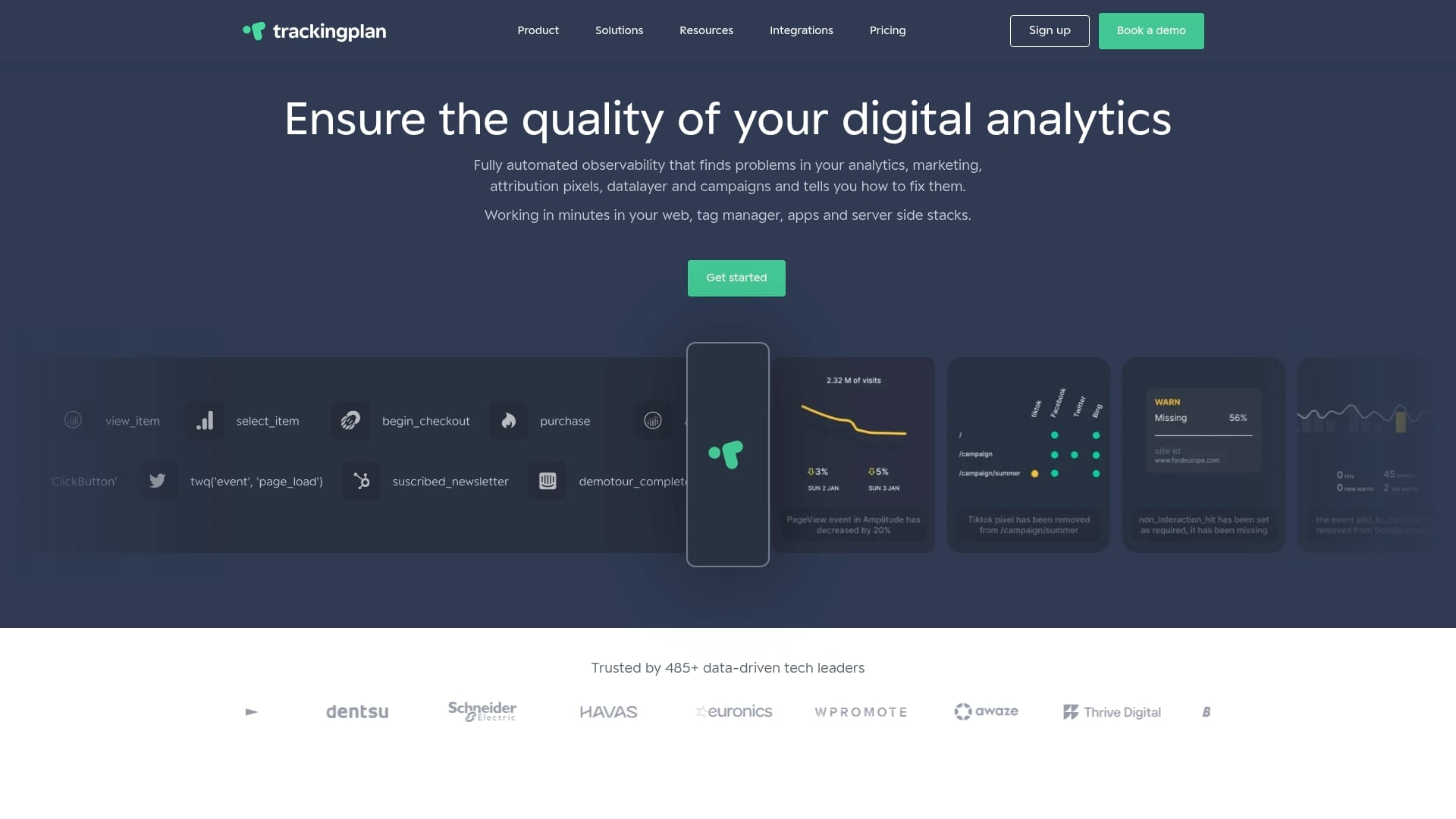
With Trackingplan, marketing leaders and compliance officers can monitor web tracking deployments across every environment, ensure all digital analytics tools are firing correctly and within consent boundaries, and access a dedicated privacy hub for GDPR and CCPA compliance oversight. Real-time alerts via Slack, email, or Teams mean your team finds out about compliance failures in minutes, not months. That is the difference between a routine fix and a regulatory incident.
Frequently asked questions
What is compliance tracking in digital marketing?
It’s the continuous monitoring of regulatory obligations, user consent, and data usage to ensure marketing campaigns meet legal and privacy standards. As defined by industry guidance, compliance tracking includes monitoring licenses, certifications, permits, and regulatory obligations relevant to your specific industry requirements.
How does real-time compliance monitoring benefit marketing teams?
It reduces risks and costs by detecting issues immediately, automating evidence collection, and keeping the organization audit-ready at all times. Organizations using automated GRC tools for real-time compliance tracking report up to a 40% reduction in compliance-related expenses.
What makes Google Consent Mode v2 important in 2026?
It enables recovery of most conversion data from users who decline cookies while ensuring GDPR compliance for EU-targeted advertising. Specifically, Google Consent Mode v2 recovers 70-80% of conversion data from users declining cookies, which makes it essential for any team running EU-targeted campaigns.
What common challenges prevent effective compliance tracking?
Challenges include fragmented tracking systems, unclear ownership, missing real-time alerts, and infrequent audits leading to unnoticed compliance gaps. Fragmented tracking using spreadsheets leads to unresolved risks, making centralized risk registers and time-bound workflows the more reliable path to audit readiness.
Why is self-reporting to regulators beneficial in compliance?
Self-reporting and timely remediation lead to reduced penalties and more favorable treatment during regulatory examinations. SEC enforcement data confirms that organizations with proactive self-reporting and remediation consistently secure reduced penalties and stronger regulatory relationships.